Author Archives: freeandclear

Borrowers Continue to Turn to Big Banks When Shopping for a Mortgage

Big banks may be losing share of the mortgage market but they continue to hold mindshare when borrowers shop for mortgages.  While specialized mortgage banks have experienced significant growth over the past several years, most mortgage borrowers still turn to big banks when they compare lenders according to the FREEandCLEAR Mortgage Survey.


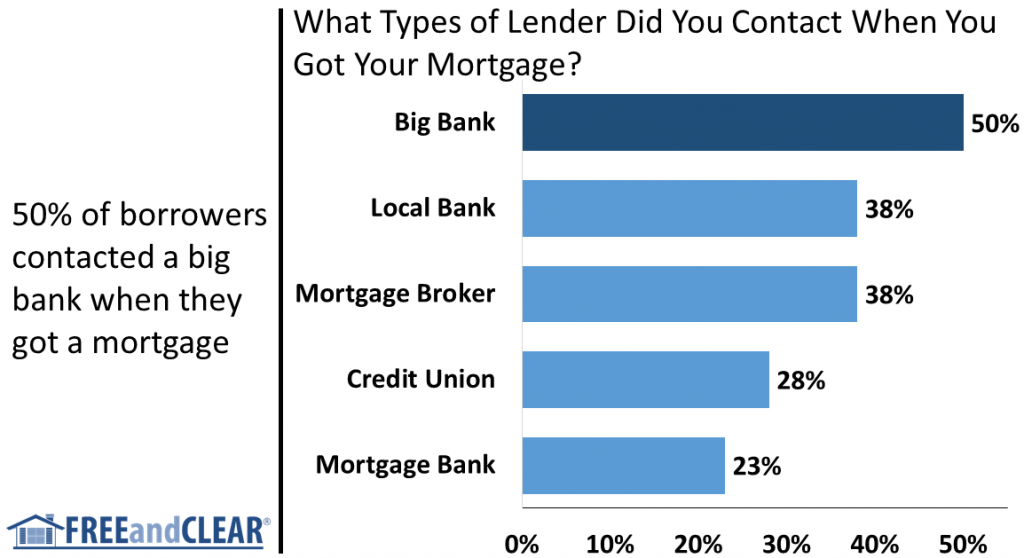
When asked “what type of lenders did you contact when you got your mortgage (select all that apply)?”, 50% of borrowers selected “Big Bank”, which ranked as the top survey response.  Given the tarnished reputation of big banks as well as recent scandals, we were somewhat surprised that borrowers selected big bank more than any other type of lender.  The high ranking for big banks is likely attributable to borrowers having existing checking or savings account relationships with the banks as well as borrowers wanting to get a mortgage quote from a known brand.
 

types of lenders for mortgage

Types of lenders borrowers contact for a mortgage


The surprising results extended beyond the top of the survey as smaller, local lenders placed relatively high.  “Local Bank” and “Mortgage Broker” tied for the second highest response, with each type of lender garnering 38% of borrower responses.  Industry regulations implemented since the mortgage crisis have made business more challenging for both smaller lenders and mortgage brokers but they continue to be an important resource for borrowers and more importantly, a viable lending option.  The results of the FREEandCLEAR Mortgage Survey suggest that borrowers like having multiple lender choices — both big and small — when they shop for a mortgage.


The bottom results of the survey are also highly informative with “Credit Union” and “Mortgage Bank” ranking fourth and fifth, respectively.  28% of borrowers said that they contacted a credit union when they got a mortgage, which is roughly consistent with credit unions’ share of the overall mortgage market.  As credit unions continue to grow their membership bases and expand their mortgage lending options you would expect them to increase their borrower mindshare in the future.


Perhaps the most surprising finding from the survey is that only 23% of borrowers said that they contacted a “Mortgage Bank” when they got a mortgage.  Mortgage banks that focus exclusively on mortgages without taking borrower deposits or offering other lending products have gained significant market share over the past half decade.  Despite their strong growth, mortgage bank attracted the lowest response rate among surveyed borrowers.  There are several possible explanations for why mortgage bank ranked so low.  First, because the definition of a mortgage bank is relatively technical, borrowers may not differentiate between a mortgage bank and other types of lenders when they shopped for their loan.  We hypothesize that a higher percentage of borrowers contacted mortgage banks without actually realizing the lender was a mortgage bank.


The second factor that contributed to the disconnect is that while fewer borrowers may shop mortgage banks, more borrowers may select them for their loan.  For example, a borrower may not contact multiple lenders before deciding to use a mortgage bank for their loan.  Larger mortgage banks tend to advertise heavily which may attract more customers directly.  While FREEandCLEAR advocates that borrowers always shop multiple lenders for a mortgage, some borrowers may be persuaded by a lender’s marketing messages.  Whatever the reason, we expect mortgage banks to attract a greater share of mortgage shoppers in the future.


While the mortgage lender landscape continues to shift, the results of the FREEandCLEAR Mortgage Survey reinforce how important options are for borrowers.  Whether borrowers contact old school big banks, local banks or mortgage banks, the ability to shop multiple types of lenders remains key to borrowers finding the mortgage that is right for them.


We will continue to provide a detailed analysis of each survey question on our blog in the coming weeks and you can review the full results from the FREEandCLEAR Mortgage Survey to better understand how borrowers think about and experience the mortgage process.

New Mortgage Guidelines Help Buyers Afford More Home

Recently, Fannie Mae, the government-sponsored enterprise that helps to determine mortgage guidelines, increased the debt-to-income ratio that lenders use to determine what size mortgage borrowers qualify for.  You may not have heard of Fannie Mae because it is not an actual lender but it plays a very important role in the mortgage process.  Fannie Mae buys mortgages from lenders which in turn enables them to issue more mortgages to borrowers.  Fannie Mae is the largest purchaser of mortgages in the country so when it changes a rule or regulation the impact on the mortgage market — including both lenders and borrowers — is significant.


Fannie Mae’s decision to increase the borrower debt-to-income ratio is one of the most important mortgage guideline changes in years because it directly affects how much mortgage borrowers can afford. A debt-to-income ratio represents what percentage of your monthly gross income you spend on debt expenses including your mortgage payment, property tax, homeowners insurance and homeowners association fees (if applicable) as well as other debt payments such as for credit card, auto and student loans plus alimony, spousal or child support payments, if applicable.  In short, if you add up all your monthly housing and non-housing related debt payments and divide that figure by your monthly gross income, the result is your debt-to-income ratio.


The previous Fannie Mae guideline permitted a debt-to-income ratio of 43%, which meant that borrowers could spend a maximum of 43% of their monthly gross income on total monthly debt payments, including total monthly housing expense.  The new Fannie Mae guideline increases the debt-to-income ratio to 50%, which means borrowers are permitted to spend 50% of their monthly gross income on total monthly debt payments.  The increase is important because the higher the debt-to-income ratio, the higher the mortgage amount you can qualify for.


The change in debt-to-income ratio from 43% to 50% significantly increases the mortgage amount borrowers can afford according to Fannie Mae rules.  The example below compares what size mortgage a borrower can afford under the new 50% debt-to-income ratio as compared to the old 43% debt-to-income ratio.  In this example, the borrower makes $5,000 in monthly gross income and has $500 in monthly non-housing related debt payments (such as credit card and auto loan payments).  As illustrated by the example, under the new guideline, the borrower can afford a mortgage of approximately $342,900, as compare to a mortgage of $282,900 under the old guideline, an increase of $60,000, or 21%.  Please note that this example makes an assumption for property tax and insurance which vary by county and other factors, but the outcome generally remains the same across all borrower scenarios.          


   Old Ratio

(43%)

   New Ratio

(50%)

Monthly Gross Income

$5,000

$5,000

Monthly Debt

$500

$500

Estimated Monthly Housing Expense Plus Total Monthly Debt

$2,150

$2,500

Estimated Monthly Housing Expense

$1,650

$2,000

Estimated Monthly Mortgage Payment (P&I)

$1,310

$1,590

Estimated Mortgage Amount for Which You Qualify

$282,900

$342,900


While this example represents only one case, it demonstrates how the new debt-to-income ratio enables borrowers to qualify for a significantly higher mortgage amount, which enables them to buy more home. Borrowers can use our Mortgage Qualification Calculator to determine what size mortgage they can afford based on the new debt-to-income ratio guideline and their specific financial profile


In this case, the borrower could potentially afford to spend $60,000 more on a home.  In other cases, borrowers who thought they could not afford to buy a home in a particular neighborhood may have new options.  And other buyers who thought they were priced out of buying a home altogether may now be able to afford a home.  In summary, the new debt-to-income ratio increases purchasing power and expands the pool of people who can afford to buy a home.


There are a couple of important points to keep in mind about the new debt-to-income ratio.  First, while Fannie Mae rules are guidelines, some lenders may impose stricter internal rules, called lender overlays, which means some lenders may not apply the higher debt-to-income ratio.  FREEandCLEAR surveyed multiple lenders, however, and they all indicated that they are using the higher ratio.


Second, the new guideline does not apply to all mortgage programs.  Government-backed mortgage programs such as the FHA, VA and USDA programs apply their own guidelines and typically use a lower debt-to-income ratio.  Additionally, some lenders may offer proprietary mortgage programs that use a lower or higher debt-to-income ratio.  Borrowers should understand up-front what debt-to-income ratio their lender uses as well as the income and debt inputs used to calculate the ratio.


Finally, while the new debt-to-income ratio enables borrowers to qualify for a higher loan amount, that does not always mean that is the right mortgage for you. The most important factor in deciding what size mortgage you can afford is that your are financially comfortable with your monthly mortgage payment and total monthly housing expense over the long term.  The worst outcome when you get a mortgage is that you end up with a monthly payment that you cannot afford.  Regardless of your debt-to-income ratio or what a lender tells you, it is ultimately up to you to choose a loan amount that you can afford.

How Borrowers Find a Mortgage Lender

It seems like the Internet is replacing traditional methods of shopping in almost every area of commerce.  Whether its groceries, clothes, electronics, travel, cars, real estate and just about any product you can imagine, people are turning to the Internet to search for, research, compare and buy products and services.


At FREEandCLEAR we want to understand how this tidal wave of online shopping is impacting how borrowers search for and select their mortgage lender.  Is the mortgage market similar to other industries where we would not think of making a purchase without first researching our options online?  I mean, who would buy an airline ticket without checking out an online travel website to compare flight prices.  Where we used to turn to a travel agent to book our flights (remember when), we now turn to the Internet.  Online shopping has fundamentally changed the way we shop for travel and so many other products and services, but what about mortgages? Has technology replaced people and relationships when it comes to finding a mortgage lender?


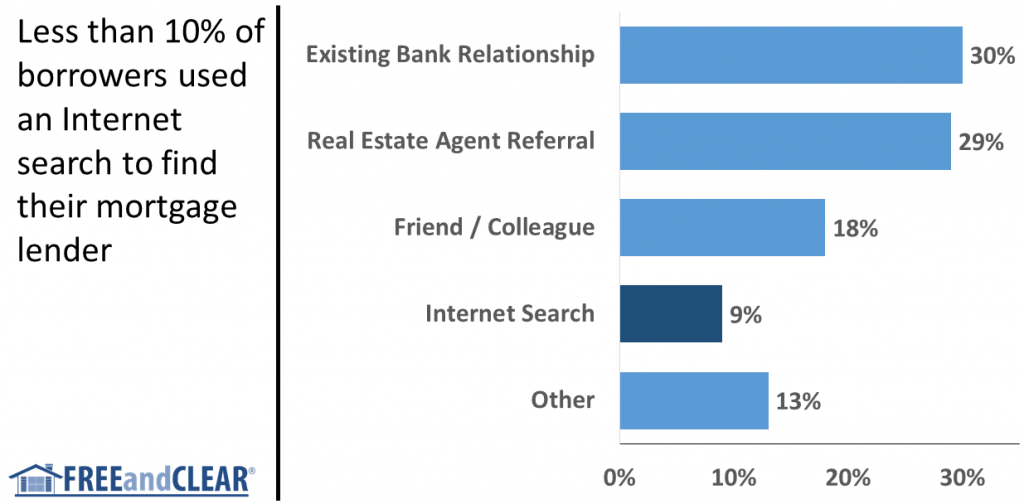
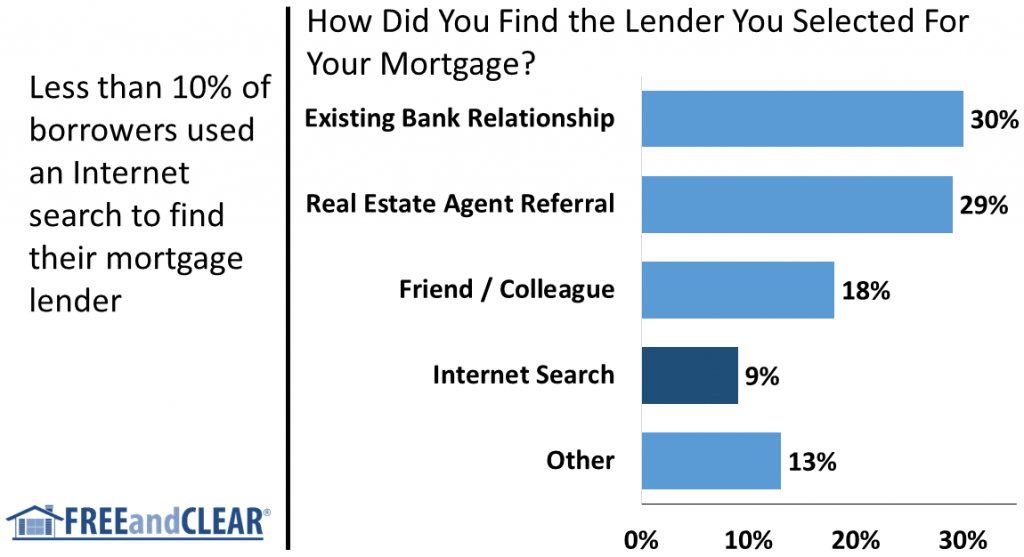
According to the surprising results of the FREEandCLEAR Mortgage Survey, the answer is a resounding no.  Based on our findings, the mortgage industry is one of the last remaining market segments where relationships, not technology, drive the selection process.   When asked how did you find the lender you selected for your mortgage, 30% of borrowers selected an existing bank relationship, 29% of borrowers selected a real estate agent referral and 18% selected a friend or colleague.  So in total, 77% of survey respondents indicated they relied on a personal relationship to find their mortgage lender — an astoundingly high figure when compared to other product and service categories that seemed to have been overtaken by the Internet.


How  borrowers find mortgage lenders

Borrowers rely on personal relationships to find mortgage lenders


Perhaps what is most shocking about the FREEandCLEAR Mortgage Survey is how low the Internet ranked in the results as only 9% of borrowers selected Internet search when asked how they found their lender.  Based upon these findings, relationships outweigh technology when borrowers select a mortgage lender by an almost almost 9-to-1 margin.  Compared to other product and service categories where technology is replacing people, it seems that borrowers still prefer “old school” methods when selecting a lender.  Whether it is with your bank, real estate agent, friend or business colleague, relationships still matter when it comes to mortgages.


The survey results are fascinating and raise the important question of why the Internet and online shopping has not transformed the mortgage market as it has so many other areas of our lives?  What is it about mortgages that leads people to rely on relationships instead of the Internet when they make a purchase decision?


Our hypothesis is that the complicated and sometimes overwhelming nature of the mortgage process leads borrowers to seek more personal approaches to finding a lender.  Mortgages are far more complex than commodity products like airline tickets so maybe it should not come as a surprise that borrowers rely on relationships when they “shop” for lenders.  While you may be comfortable using the Internet to shop for a new television, getting a mortgage can be confusing and it is not something most people do on a regular basis.  Plus, a mortgage is a lot more money than the price of an airline ticket or television.


While websites like FREEandCLEAR and others are making it increasingly easy to compare mortgage lenders, people will always play an important role in the lender selection process.  As more millennials buy homes we expect that more borrowers use the Internet to shop for mortgage lenders but use technology to complement, not replace, our trusted relationships.


We will continue to provide a detailed analysis of each survey question on our blog in the coming weeks and you can review the full results from the FREEandCLEAR Mortgage Survey to better understand how borrowers think about and experience the mortgage process.

How Many Lenders Do Borrowers Shop For a Mortgage?

Shopping around is one of the best ways to make sure that you find the best deal when you make a major purchase.  Whether you are looking to buy a car, television or airline ticket, consumers are accustomed to comparing multiple vendors to find the lowest  price and often use the Internet to help with the comparison shopping.


Aside from actually buying a home, getting a mortgage is perhaps the largest financial purchase most people make so FREEandCLEAR wants to understand how many lenders  borrowers shopped when they selected their mortgage lender.  It is not uncommon to shop four or more auto dealers, retailers or airlines when you buy a car, television or plane ticket, respectively, but what about mortgage lenders?  With so much money on the line — the average borrower spends hundred of thousands of dollars in interest expense over the life of their mortgage — you would expect that borrowers shop lenders at least as much as they do when they buy a television, right?


According to the FREEandCLEAR Mortgage Survey, however, the answer is no.  Although a  mortgage is usually one of the biggest financial commitments most of us make and despite how just a small decrease in your interest rate and closing costs can save you thousands of dollars, most borrowers said they did not shop around when they selected their lender.  When asked how many lenders did you compare when you got your mortgage, 36% of borrowers responded that they only contacted one lender and 28% of borrowers said they contacted only two lenders.  So almost two-thirds of borrowers (64%!) shopped two or fewer lenders when they got a mortgage.  It is crazy to think that the majority of borrowers shop more for a television than they do for a mortgage!


How Many Mortgage Lenders Borrowers Shop

How Many Lenders Do Borrowers Shop When They Get a Mortgage


So how many lenders should borrowers shop when they get a mortgage?  Although every borrower is different, the number is definitely greater than one or two and usually greater than three.  FREEandCLEAR advises borrowers to compare at least four lenders when they shop mortgages so that they can review a range of proposals and find the loan with the lowest rate and closing costs (shameless plug alert: our INTEREST RATES function makes it super easy to compare multiple mortgage lenders).   Our survey results make you wonder how much money borrowers are leaving on the table by not shopping lenders more extensively — potentially billions of dollars.  


The findings from the FREEandCLEAR Mortgage Survey, however, were not all negative.  14% of borrowers said they compared four or more lenders when they got a mortgage and a combined 36% of respondents said they shopped three or more lenders.  So a little more than a third of borrowers appear to be making more informed decisions when they select their mortgage lender.


While this slice of the survey results is certainly positive, it also reinforces a tremendous opportunity for the majority of borrowers.  Although shopping mortgage lenders takes extra time and effort, it is free for borrowers and can save them a lot of money.  If we are all thrilled to save a few bucks when we buy a new television, we should be ecstatic to save thousands on our mortgage.


We will continue to provide a detailed analysis of each survey question on our blog in the coming weeks and you can review the full results from the FREEandCLEAR Mortgage Survey to better understand how borrowers think about and experience the mortgage process.

FREEandCLEAR Mortgage Survey: How Borrowers Select Mortgage Lenders

FREEandCLEAR is excited to released the second set of results from its ground-breaking Mortgage Survey.  The latest results offer captivating insights into how borrowers select mortgage lenders.


The survey examines key mortgage topics including how many lenders borrowers shopped when they got a mortgage, what types of lenders borrowers contacted and how borrowers found the lender they chose.  Among the captivating findings: 77% of borrowers used an existing bank relationship, real estate agent or personal referral to find their mortgage lender while only 9% used an Internet search, showing that personal relationships trump the Internet when it comes to selecting a mortgage lender.


How Borrowers Find Mortgage Lenders

Less than 10% of borrowers used an Internet search to find their mortgage lender according to the FREEandCLEAR Mortgage Survey


The results also showed that 36% of borrowers compared only one lender and 64% compared two or less lenders when they got a mortgage, suggesting almost two thirds of borrowers may be leaving money on the table by not shopping lenders more extensively.  You can view the latest survey results at FREEandCLEAR Mortgage Survey.


“Our mortgage survey continues to enable us to gather invaluable insights into borrower behavior” said FREEandCLEAR Co-Founder Michael Jensen.  “These results enable us to really understand the factors that drive the borrower decision-making process.”


The survey reinforced some perceived notions about the mortgage industry while also producing some surprising findings.  “We knew the mortgage market lagged other industries in terms of Internet adoption but we were shocked to see just how ‘old school’ the lender selection process is for most borrowers. It’s a significant opportunity for lenders and other industry participants” said Jensen.


Additional results of the FREEandCLEAR Mortgage Survey will be revealed in the coming months.  Future releases of survey results explore important topics such as Borrower Education and Improving the Mortgage Process.


About FREEandCLEAR

FREEandCLEAR is a leading mortgage website that offers free tools and resources that empower people to find the mortgage that is right for them.  FREEandCLEAR was developed by a father and son team who are on a mission to help people make better decisions and save money when they get a mortgage.  Our valuable resources and mortgage rate tables put borrowers in control of the mortgage process and enable them to easily shop for a mortgage.

The Mortgage Industry Consumes Over 260,000 Trees Annually

At first thought there does not seem to be a common thread between mortgages and Earth Day but when you consider the volume of paperwork involved in the mortgage process the connection becomes more clear.  Mortgage document overload represents a significant concern for both borrowers and the environment.


Mortgage paperwork can overwhelm even the most experienced borrowers.  In some cases borrowers are required to review and sign over 50 loan documents.  According to the recent FREEandCLEAR Mortgage Survey, when asked to select the most challenging part of the mortgage process, the number one response was paperwork which garnered 56% of responses — more than four times the second place response of borrower qualification.


Borrowers have good reason to feel confused and burdened by mortgage paperwork.  The table below outlines an extensive list of documents that borrowers may encounter over the course of the mortgage process.  The table also details the approximate number of pages for each document.  Although mortgage documents and length vary depending on several factors such mortgage program and type as well as borrower location, the table illustrates how borrowers can drown under a sea of paperwork.


Mortgage Document List

Mortgages require a lot of paperwork


Most of the documents listed in the table serve a legal or regulatory purpose and are intended to inform or protect the borrower; however, we may have reached the point where more is less when it comes to mortgage paperwork.  The mounds of documents and pressure to close can create a challenging dynamic for borrowers.  In the worst case scenario, borrowers eager to close their mortgage sign whatever papers are put in front of them at the closing table without fully understanding the documents.


While mortgage paperwork poses a confusing and cumbersome challenge for borrowers it also has significant environmental ramifications.  In recognition of Earth Day, we quantified how mortgages impact the environment.


According to a recent Federal Reserve Bulletin on residential mortgage lending, there are on average 7.8 million mortgages a year.  This figure is based on the average number of purchase, refinance, home improvement and multifamily mortgage originations between 2011 and 2015, the most recent year for which data are available. 7.8 million is a lot of mortgages and that figure does not even include the number of loan applications that did not successfully result in a closed loan, which was almost five million in 2015.


When you multiply the large number of mortgages by the high number of mortgage documents the product is a massive amount of paperwork and tremendous environmental impact. Specifically, 7.8 million mortgages per year times 280 pages of paper per mortgage yields almost 2.2 billion sheets of paper consumed by mortgages annually.


To quantify the environmental impact of 2.2 billion sheets of paper we used the Environmental Paper Network Paper Calculator.  (The Environmental Paper Network (EPN) is an organization that works for social and environmental transformation in the production and consumption of pulp and paper.  For more information visit www.papercalculator.org)


According to the EPN Calculator, 2.2 billion sheets of paper equals approximately 4.4 million reams, or 11,000 tons, of paper.  The EPN estimates that 11,000 tons of paper require over 41,000 tons of wood to produce, which is equivalent to approximately 264,000 trees.  So in short, mortgages consume approximately 264,000 trees annually.


Mortgages use a lot of trees

Over 260,000 trees are consumed by mortgages annually


Although double-sided printing and digital documents reduce paper consumption in the mortgage process these practices are more than offset by the millions of loan applications that did not result in a mortgage as well as lenders’ internal document retention requirements.  In light of these factors we believe that 264,000 tree consumption figure is likely conservative.  While the increasing use of recycled paper is certainly positive, there is little doubt that the mortgage industry’s impact on the environment and trees is profound.


And the environmental impact of mortgage paperwork is not limited to trees.  In addition to wood usage, paper production involves considerable energy and water consumption and generates significant greenhouse gas emissions and waste.  The table below provides a more complete estimate of the environmental impact of 2.2 billion sheets of paper and illustrates that mortgage documentation is as tough on the planet as it is on borrowers.


Environmental impact of mortgage documents

Based on 2.2 billion sheets of paper. Source: Environmental Paper Network


So what steps can be taken to address both the borrower overload and environmental impact caused by mortgage paperwork?  The adoption of online and mobile technologies that permit borrowers to digitally upload their financial paperwork is a good start but these technologies are not widely implemented and do not change the number of documents involved in the mortgage process.  Changing regulations that prohibit the use of digital signatures for most mortgages could also have a positive impact but raises a different set of borrower concerns.


“Less paperwork” is the obvious answer to both borrower and environmental challenges but it seems unlikely that government regulators will eliminate or streamline any documents that are designed to protect borrowers, especially as the long-term effects of the the mortgage crisis continue to linger.


Big problems usually lack easy solutions and that certainly applies to the issue of mortgage paperwork.  Despite meaningful obstacles, lenders and regulators have a tremendous opportunity to collaborate to implement solutions that address mortgage paperwork overload and move the industry forward.  Borrowers and mother nature are counting on it.

How Satisfied Are Borrowers With Their Mortgage Lender?

There are multiple factors that determine if your mortgage process was positive and successful.  Mortgage rate, closing costs, timeline and lender customer service are all important inputs to your mortgage experience.  While all these components are important, there is perhaps no better measure of the mortgage experience than borrower satisfaction with their lender.


In a way, borrower lender satisfaction encompasses all elements of the mortgage process.  If you are unhappy with your mortgage rate or final closing costs, you are unlikely to be happy with your lender.  If you missed your mortgage closing deadline, you probably blame it on the lender even if it is not their fault.  When customer service fails to meet expectations, lenders definitely bear the brunt of borrower frustrations.


Given its importance as a broad barometer of the mortgage experience, measuring borrower satisfaction with their lender was a key objective of the FREEandCLEAR Mortgage Survey.  The survey results indicate the lenders are doing a highly satisfactory job of meeting borrower expectations.


When asked to rate how satisfied they are with their mortgage lender on a scale of 1 to 10, with ten being the highest level of satisfaction, a robust 78% of respondents selected 7 or higher.  Furthermore, the four highest lender satisfaction options achieved the four top-ranked responses, in order.  The highest borrower satisfaction rating of 10 garnered 24% of responses followed by a 9 rating which drew 21% of responses and an 8 rating with attracted 20% of responses.


Borrower satisfaction with mortgage lenders

Borrowers are satisfied with their mortgage lender


Although the results are generally positive, there are some modest causes for concern.  The middle borrower satisfaction rating of 5 registered 9% of responses, the fifth most popular choice.  Certainly no lender strives for mediocrity when it comes to borrower satisfaction.  Additionally, the lowest rating of 1 was selected by 3% of respondents, exceeding the second, third and fourth lowest rating options.


So although a significant majority of borrowers seem to be very satisfied with their mortgage lender a meaningful number of borrowers are only moderately satisfied and a relatively small number are highly unsatisfied.  These results show that some lenders have the opportunity to improve the customer experience and level of service they deliver to borrowers.


These issues, however, are more than outweighed by the overwhelmingly positive results of the survey.  The high level of borrower satisfaction is another example of the FREEandCLEAR Mortgage Survey showing borrowers with a positive opinion of their lender.  Other survey findings showed borrowers with a high level of trust in their lender as well as a very favorable assessment of how knowledgeable their lender is about the mortgage process.  In general, the survey shines a very complimentary light on an industry that had been much-maligned in the wake of the mortgage crisis.


We will continue to provide a detailed analysis of each survey question on our blog in the coming weeks and you can review the full results from the FREEandCLEAR Mortgage Survey to better understand how borrowers think about and experience the mortgage process.
How Knowledgeable Are Mortgage Lenders?

The turmoil in the mortgage market over the past several years resulted in significant personnel turnover at lenders.  Many lenders ceased operations and droves of experienced mortgage professionals changed careers or retired in response to the industry downturn.


At the same time many mortgage veterans were leaving the industry, new rules and regulations were adopted that made the mortgage process more complicated.  We are all familiar with borrower anecdotes about loan officers that did not know what they were doing, leaving us to question if the “brain drain” of knowledgeable professionals has negatively impacted the mortgage experience for borrowers.


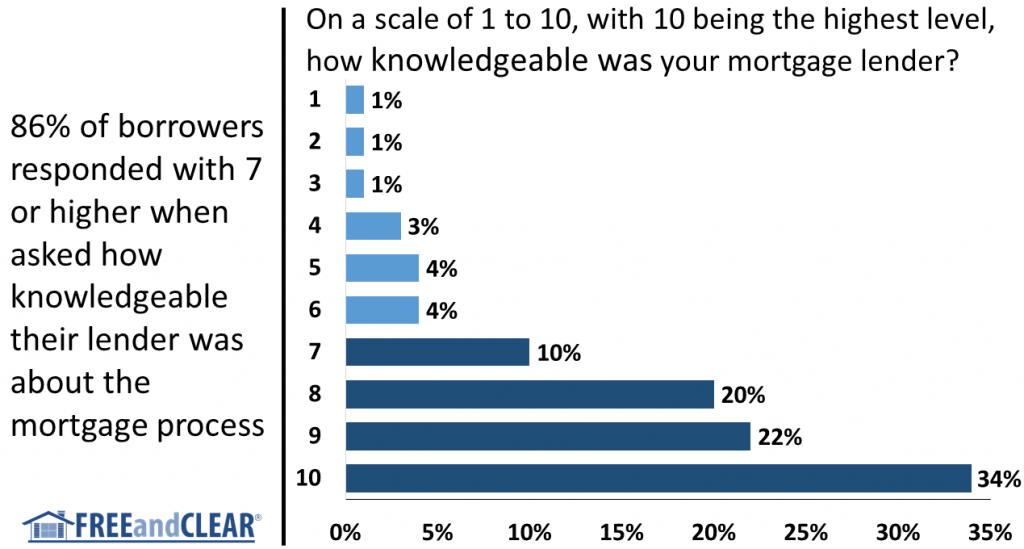
The FREEandCLEAR Mortgage Survey explored this issue and attempted to quantify if negative borrower experiences with mortgage professionals were the rule or the exception.  We asked borrowers to rate how knowledgeable their lender was about the mortgage process on a scale of one to ten, with ten being the most knowledgeable, and the results reflected very positively on today’s mortgage lenders.


How smart are mortgage lenders?

According to borrowers, lenders are highly knowledgeable about the mortgage process


The survey showed that an astounding 86% of respondents selected seven or higher when asked how knowledgeable their lender was.  The highest rating option of 10 led the way with 34% of borrowers followed by 9 with 22% of borrowers and 8 with 20% of borrowers.  In fact, the five highest rating options garnered the top five borrower responses, in order.


So despite all the changes in the mortgage industry and outflow and inflow of professional talent, most borrowers think their lender is pretty smart when it comes to the mortgage process.  


The positive borrower sentiment could be attributable to several factors.  First, many of the most experienced mortgage professionals managed to survive the market swings and remain in the industry.  Second, many high-quality professionals have returned to the industry as the mortgage market has rebounded.  Finally, new licensing rules require more ongoing lender training and education.  While these regulations may be a pain, perhaps they have produced more knowledgeable and informed lending professionals, a hypothesis certainly supported by the FREEandCLEAR Mortgage Survey.


Lenders are rightly expected to be highly knowledgeable about the mortgage process but it is still encouraging for borrowers to validate this point so emphatically.  Working with an experienced, knowledgeable lender can make the difference between a closed loan or a frustrated borrower.  The findings of the FREEandCLEAR Mortgage Survey suggest that most borrowers work with lenders that know what they are doing which is win-win for borrowers and lenders. 


We will continue to provide a detailed analysis of each survey question on our blog in the coming weeks and you can review the full results from the FREEandCLEAR Mortgage Survey to better understand how borrowers think about and experience the mortgage process.