Category Archives: Uncategorized

How Rising Mortgage Rates Affect How Much Home You Can Afford

Over the past several weeks, mortgage rates have increased .250% to .500%, depending on the loan program and lender, and have reached at a multi-year high.  Although the Federal Reserve left interest rates unchanged at its January meeting, multiple rate hikes are anticipated over the course of 2018 as strong economic and labor market conditions stoke concerns about rising inflation.


Generally speaking, when the Fed raises interest rates it means the economy is doing well — unemployment is typically low and people are making more money — which is positive if you want to buy a home.  The flip side of this positive economic news is that rising interest rates make it more challenging to afford a home.  For many prospective buyers, buying a home feels like a moving target — you feel confident about your job, you are making more money, you are finally ready to buy a home — but then higher mortgage rates make it harder to qualify for a mortgage.  But how much harder?


Below, we use a borrower example to quantify how an increase in mortgage rates impacts what size mortgage you can afford.  In this example, the borrower makes $60,000 a year, or $5,000 a month, in gross income (the median annual income in the United States is $59,000) and has $500 in monthly debt payments such as credit card, auto and student loans.


The chart demonstrates what size mortgage the borrower can afford based on various mortgage rates — the higher the mortgage rate, the lower the mortgage the borrower can afford.  At a 4.000% mortgage rate, our example borrower can afford a $332,635 mortgage while at a 6.000% mortgage rate, the borrower can only afford a $264,843 mortgage.  While we do not anticipate that mortgage rates will reach 6.000% this year, this example effectively illustrates how rising mortgage rates impact your ability to qualify for a mortgage.


what size mortgage you can afford at different mortgage rates

The higher the mortgage rate, the lower the mortgage amount you can afford


Now let’s take this example one step further to understand how an increase in mortgage rates affects how much home you can buy.  Using the same example scenario as above — a borrower with $5,000 in monthly gross income and $500 in monthly debt payments and a range of mortgage rates from 4.000% to 6.000% — the chart below shows what price home the borrower can afford, assuming the borrower makes a down payment of 20% of the property purchase.  While it is certainly possible to buy a home with a lower down payment (check out these no or low down payment programs), a 20% down payment typically enables you to receive a lender’s lowest mortgage rate.  The chart illustrates how rising mortgage rates reduce how much home you can buy.  At a 4.000% mortgage rate, our example borrower can buy a $415,794 home while at a 6.000% mortgage rate, the borrower can only afford to buy a $331,054 home.


what price home you can afford at different mortgage rates

The higher the mortgage rate, the less home you can afford


By this point, our analysis makes it pretty clear that higher mortgage rates do not help prospective home buyers, but let’s understand the issue from one more angle.  Let’s say you have your heart set on buying your dream home.  You found the home, you are ready to put in an offer and all you need to do is figure out ft you can afford the mortgage required to buy the home.  In this example, your dream home costs $250,000 and you plan to make a 20% down payment ($50,000), which means you need a $200,000 mortgage. But can you afford the monthly payment?  The answer to that question depends on the mortgage rate.


The chart below shows the monthly mortgage payment for a $200,000 mortgage based on different mortgage rates.  The chart illustrates how rising mortgage rates increase your monthly mortgage payment.  At a 4.000% mortgage rate, the monthly mortgage payment on a $200,000 30 year fixed rate mortgage is $955 while at a 6.000% mortgage rate, the monthly mortgage payment is $1,199.  So depending on how much money our borrower makes, higher mortgage rates may push the dream home out of reach.


Monthly mortgage payment based on mortgage rate

The higher the mortgage rate, the higher your monthly payment


In light of this analysis it is important to highlight that it is impossible to predict mortgage rates.  While most industry experts expect mortgage rates to increase in 2018, a host of economic events could produce a different outcome.  Understanding how rising mortgage rates impact what size mortgage you can afford and home you can buy prepares prospective home buyers no matter what direction mortgage rates move.

Borrowers Admit They Are Not Knowledgeable About Mortgages

The only thing worse than not knowing something is thinking you know something when you really do not.  When it comes to mortgage borrowers, the bad news is that most borrowers are not knowledgeable about mortgages.  The good news is that most borrowers recognize they are not knowledgeable about mortgages.


According to the FREEandCLEAR Mortgage Survey, approximately 60% of borrowers rated themselves a six or lower when asked how knowledgeable they are about mortgages, on a scale of one to ten, with ten being the most knowledgeable.  So six out of ten borrowers gave themselves a grade of D or below when asked to assess how much they know about mortgages.  Getting a mortgage to buy a house is one of the largest financial commitments most people make and the survey results demonstrate that borrowers are painfully uninformed about mortgages, but at least they admit it.


mortgage borrower knowledge

Borrowers are not very knowledgeable about mortgages


Our mortgage survey also asked borrowers a series of follow-up question to evaluate their self-assessment.  We were hoping that these questions would demonstrate that borrowers know more about mortgages then they think and they were grading themselves too critically.  It turns out that borrowers assessed themselves relatively honestly as many borrowers lack knowledge about mortgage fundamentals.


For example, we asked borrowers for what type of mortgage can the monthly payment change — fixed rate mortgage, interest only mortgage and adjustable rate mortgage — and select all that apply.  18% of borrowers said that the mortgage payment on a fixed rate mortgage can change over the course of the loan while only 20% of borrowers said the payment can change on an interest only mortgage.  The monthly payment on a fixed rate mortgage never changes while the payment on an interest only mortgage can fluctuate and increase over the life of the loan.  These results reflect borrowers’ lack of understand of how different mortgage programs work.  On a more positive note, 84% of survey respondents correctly answered that the monthly payment on an adjustable rate mortgage is subject to change, although the 16% of respondents who got this question wrong certainly raises a red flag.


Payment changes for what type of mortgage

Many borrowers do not understand how mortgage programs work


We also asked borrowers to select the length of mortgage you pay the least amount of interest on over the life of the mortgage — 10 year, 15 year, 20 year or 30 year mortgage.  28% of borrowers answered this question incorrectly with 9% of borrowers selecting a 30 year mortgage, which requires borrowers to pay the most amount of interest over the life of the loan.  While 72% of respondents selected the correct answer — 10 year mortgage — the results of this questions demonstrate that many borrowers do not understand mortgage basics including how your mortgage term impacts how much interest you pay over the course of your loan.


Mortgage length interest expense

Many borrowers did not select the length of mortgage that requires the least interest expense


Our mortgage survey is designed to highlight important issues such as borrower knowledge.  This latest batch of survey results reinforce how much work needs to be done to ensure that borrowers are informed when they get a mortgage.  Educating borrowers is a significant challenge that requires participation from all members of the real estate, mortgage and education communities, and especially the involvement of borrowers.  The good news is that most borrowers realize they need it.

Many Borrowers Unaware of Low Down Payment Mortgage Programs

Saving enough money for a down payment is one of the biggest obstacles to buying a home, especially for first-time home buyers looking to crack the market.  Over the past several years rising rents and relatively stagnant wage growth have magnified the down payment challenge and many prospective home owners remained locked out of owning a home.  This dynamic helps explain why the homeownership rate in the U.S. continues to hover near a historical low and why first-time home buyers comprise a smaller portion of overall buyers as compared to the past 20 years.


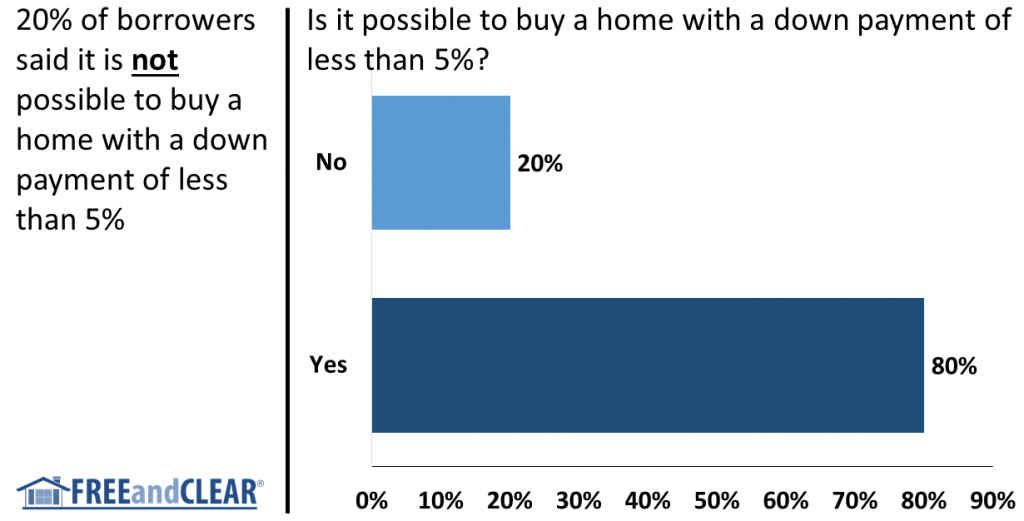
In light of these trends, mortgage programs that enable you to buy a home with little or no down payment should be gaining in popularity.  It appears, however, that a significant portion of borrowers are unaware of the wide range of low down payment programs available to them.  According to the FREEandCLEAR Mortgage Survey, 20% of borrowers said it is not possible to buy a home with a down payment of less than 5%.  So one in five survey respondents may be missing out on home ownership assistance programs that significantly improve their ability afford to buy a home.


Borrowers are unaware of low down payment mortgage programs

Many borrowers are unaware of low down payment mortgage programs


The question becomes, why are more borrowers not aware of these potentially helpful mortgage programs?  There certainly is not a lack of no or low down payment mortgage programs including both government-backed and conventional options.  On the government-sponsored side, the VA and USDA home loan programs enable eligible applicants to buy a home with no money down while the FHA mortgage program requires a down payment of 3.5% and the HUD Section 184 Program only requires a down payment of 2.25% (for loans above $50,000).


On the conventional side, the HomeReady and Home Possible mortgage programs only require a down payment of 3.0%, Fannie Mae also sponsors a standard 3.0% down program and a number of lenders even offer 1% down mortgage programs.  Additionally, Bank of America, Chase, Citibank, Wells Fargo and numerous other lenders offer conventional mortgage programs that enable you to buy a home with a down payment of 3.0% to 5.0%.  Given the countless options it is certainly surprising that many prospective home owners do not know that these programs exist.


Some borrowers might think that no or low down payment mortgage programs were eliminated when tighter lending standards were implemented following the mortgage crisis.  Although new lending guidelines may make it more challenging to qualify for a mortgage, home buyer assistance programs remain a viable option for many borrowers.  In fact, we have experienced an increase in the number of these programs over the past several years.


While it may be impossible to pinpoint why so may borrowers do not know about home ownership assistance programs it is clear that more needs to be done to educate prospective homeowners about the benefits of these programs.  While each program has its pros and cons, including extra costs in some cases, they can be a highly valuable resource for people who think owning a home is out of reach.  Increasing awareness of no and low down payment mortgage programs could help more people buy homes, which is good for both borrowers and lenders.


We will continue to provide a detailed analysis of each survey question on our blog in the coming weeks and you can review the full results from the FREEandCLEAR Mortgage Survey to better understand how borrowers think about and experience the mortgage process.

2018 VA Loan Limits Rise

The recovery in the housing market and higher property values means higher VA loan limits for 2018.  That makes two years in a row that the Federal Housing Finance Agency (FHFA), the government body that the Department of Veterans Affairs uses to determine VA loan limits, increased loan limits.  This is only the second time in over a decade that the VA loan limits increased, demonstrating the general strength of the real estate sector and appreciating home prices.  Specifically, the basic standard 2018 VA loan limit for a single unit property increased by approximately 7%.


The 2018 VA loan limits are important because they are used to determine what size loans are permitted according to VA Home Loan Program guidelines.  In short, the VA guarantees 25% of the loan amount up to the loan limit.  The higher the VA loan limit, the higher the mortgage amount you may be able to qualify for and the more home you can afford.


2018 VA Loan Limits

2018 VA Loan Limits are increasing


Please note that it is possible to obtain a mortgage amount that is greater than the VA loan limit but lenders typically require borrowers to make a down payment equal to 25% of the amount by which the mortgage exceeds the loan limit.  So while technically there is no maximum VA mortgage amount according to program guidelines, in practice the VA loan limits effectively restrict what size mortgage most borrowers can obtain using the VA Home Loan Program.


Below, we outline the VA loan limit changes and summarize the FREEandCLEAR resources you can use to determine the 2018 VA loan limit for your county.  Please note that there is one set of VA loan limits for the contiguous United States, District of Columbia and Puerto Rico and a higher set of loan limits for Alaska, Guam, Hawaii and the U.S. Virgin Islands.  Additionally, within each region there is a basic standard VA loan limit and a high cost VA loan limit for properties located in counties with higher home prices.


2018 VA Loan Limits — United States, District of Columbia and Puerto Rico

In the contiguous United States, Washington D.C. and Puerto Rico, the general VA loan limit increases from $424,100 to $453,100 in 2018. The table below compares the general 2018 VA loan limit to the 2017 loan limit.


Contiguous United States, District of Columbia and Puerto Rico
Basic Standard VA Loan Limits
Number of Units 2018 2017 Change (%)
1 $ 453,100 $ 424,100 6.8%


In the contiguous United States, Washington D.C. and Puerto Rico, the high cost area VA loan limit increases from $636,150 to $679,650 in 2018.  The table below compares the high cost area 2018 VA loan limit to the 2017 loan limit.


Contiguous United States, District of Columbia and Puerto Rico
High Cost Area VA Loan Limits
Number of Units 2018 2017 Change (%)
1 $ 679,650 $ 636,150 6.8%


2018 VA Loan Limits — Alaska, Hawaii, Guam and the U.S. Virgin Islands

The VA loan limits for Alaska, Hawaii, Guam and the U.S. Virgin Islands are higher than the loan limits for the contiguous United States.  In Alaska, Hawaii, Guam and the U.S. Virgin Islands the basic standard VA loan limit increases from $636,150 to $679,650 in 2018.  The table below compares the basic standard 2018 VA loan limit to the 2017 loan limit.


Alaska, Hawaii, Guam and the U.S. Virgin Islands                           
Basic Standard VA Loan Limits
Number of Units 2018 2017 Change (%)
1 $ 679,650 $ 636,150 6.8%


In Alaska, Hawaii, Guam and the U.S. Virgin Islands, the high cost area VA loan limit increases from $954,225 to $1,019,475 in 2018.  The tables below compares the high cost area 2018 VA loan limit to the 2017 loan limit.


Alaska, Hawaii, Guam and the U.S. Virgin Islands                              
High Cost Area VA Loan Limits
Number of Units 2018 2017 Change (%)
1 $ 1,019,475 $ 954,225 6.8%


FREEandCLEAR Resources


As always, all the FREEandCLEAR resources are free to use.  We encourage you to use our tools to understand how the 2018 VA loan limits apply to you.

2018 FHA Loan Limits Increase

The improvement in the housing market and increasing home prices have resulted in higher FHA loan limits for 2018.  2018 represents the second year in a row — and only the second time in over a decade — that FHA loan limits increased.  The higher 2018 FHA loan limits underscore the overall health of the real estate industry as well as rising property values.  Specifically, the basic standard 2018 FHA loan limit for a single unit property increased by approximately 7% as compared to the 2017 FHA loan limit.


2018 FHA Loan Limits

2018 FHA Loan Limits are increasing


The 2018 FHA loan limits are important because they determine the maximum mortgage amount according to FHA Program rules.  In short, the higher the FHA loan limit, the higher the mortgage amount you may be able to qualify for and the more home you can afford.


Loan limits are especially significant for FHA mortgages because borrowers are only required to make a down payment of 3.5% of the property purchase price according to FHA Program guidelines.  Higher FHA loan limits mean that borrowers may be able to afford significantly more home without a proportional increase in their down payment.  For example, the basic standard 2018 FHA loan limit for a single unit property increases by $18,850.  So in 2018 a home buyer could potentially use an FHA loan to buy a home that costs $18,850 more with only a $660 increase in the required down payment.


Below, we outline the FHA loan limit changes and summarize the FREEandCLEAR resources you can use to determine the 2018 FHA loan limit for your county.  Please note that there is one set of FHA loan limits for the contiguous United States, District of Columbia and Puerto Rico and a higher set of loan limits for Alaska, Guam, Hawaii and the U.S. Virgin Islands.  Additionally, within the contiguous United States, District of Columbia and Puerto Rico there is a basic standard FHA loan limit and a high cost FHA loan limit for properties located in counties with higher property values.


2018 FHA Loan Limits — United States, District of Columbia and Puerto Rico

In the contiguous United States, Washington D.C. and Puerto Rico, the basic standard FHA loan limit for a single unit property increases from $275,665 to $294,515 in 2018. The basic standard 2018 FHA loan limit for a four unit unit property increases from $530,150 to $566,425.  The tables below compares the basic standard 2018 FHA loan limits to the 2017 loan limits.


Contiguous United States, District of Columbia and Puerto Rico
Basic Standard FHA Loan Limits
Number of Units 2018 2017 Change (%)
1 $ 294,515 $ 275,665 6.8%
2 $ 377,075 $ 352,950 6.8%
3 $ 455,800 $ 426,625 6.8%
4 $ 566,425 $ 530,150 6.8%


In the contiguous United States, Washington D.C. and Puerto Rico, the high cost area FHA loan limit for a single unit property increases from $636,150 to $679,650 in 2018. The high cost area 2018 FHA loan limit for a four unit unit property increases from $1,223,475 to $1,307,175.  The tables below compares the high cost area 2018 FHA loan limits to the 2017 loan limits.


Contiguous United States, District of Columbia and Puerto Rico
High Cost Area FHA Loan Limits
Number of Units 2018 2017 Change (%)
1 $ 679,650 $ 636,150 6.8%
2 $ 870,225 $ 814,500 6.8%
3 $ 1,051,875 $ 984,525 6.8%
4 $ 1,307,175 $ 1,223,475 6.8%


2018 FHA Loan Limits — Alaska, Hawaii, Guam and the U.S. Virgin Islands

The FHA loan limits for Alaska, Hawaii, Guam and the U.S. Virgin Islands are higher than the loan limits for the contiguous United States.  In Alaska, Hawaii, Guam and the U.S. Virgin Islands the FHA loan limit for a single unit property increases from $954,225 to $1,019,475 in 2018. The 2018 FHA loan limit for a four unit unit property increases from $1,835,200 to $1,960,750.  The tables below compares the general 2018 FHA loan limits to the 2017 loan limits.


Alaska, Guam, Hawaii, and the U.S. Virgin Islands                           
FHA Loan Limits
Number of Units 2018 2017 Change (%)
1 $ 1,019,475 $ 954,225 6.8%
2 $ 1,305,325 $ 1,221,750 6.8%
3 $ 1,577,800 $ 1,476,775 6.8%
4 $ 1,960,750 $ 1,835,200 6.8%


FREEandCLEAR Resources


As always, all the FREEandCLEAR resources are free to use.  We encourage you to use our tools to understand how the 2018 FHA loan limits apply to you.

2018 Conforming Loan Limits Climb

The sustained rebound in the real estate market and increase in home prices over the course of 2017 has resulted in higher conforming loan limits for 2018.  For the second year in a row, the Federal Housing Finance Agency (FHFA), the government agency that sets the conforming loan limits, announced an increase in loan limits for the coming year.  This is only the second time since 2006 that the FHFA raised conforming loan limits, reflecting the overall health of the real estate market as well as improving property values.  In fact, the general 2018 conforming loan limit for a single unit property increased by 6.8%.


The 2018 conforming loan limits are important because they help determine your mortgage rate and eligibility for certain no or low down payment mortgage programs.  In short, loan amounts that are below the conforming loan limits typically qualify for lower mortgage rates and are eligible for home buyer assistance programs.  So the higher 2018 conforming loan limits are positive for borrowers, especially as property values continue to climb.  The 2018 conforming loan limits go into effect on January 1, 2018.


2018 conforming loan limits

2018 Conforming Loan Limits are set to increase


Below, we summarize the loan limit changes and summarize the FREEandCLEAR tools you can use to determine the 2018 conforming loan limit for your county.  Please note that there is one set of conforming loan limits for the contiguous United States, District of Columbia and Puerto Rico and a higher set of loan limits for Alaska, Guam, Hawaii and the U.S. Virgin Islands.  Additionally, within each geographic classification there is a general conforming loan limit and high cost area conforming loan limit for properties located in counties with higher property values.  The conforming loan limits also vary by number of units in the property, ranging from one unit to four units.   


2018 Conforming Loan Limits — United States, District of Columbia and Puerto Rico

In the contiguous United States, Washington D.C. and Puerto Rico, the general conforming loan limit for a single unit property increases from $424,100 to $453,100 in 2018. The general 2018 conforming loan limit for a four unit unit property increases from $815,650 to $871,450.  The table below compares the general 2018 conforming loan limits to the 2017 loan limits.


Contiguous United States, District of Columbia and Puerto Rico
General Conforming Loan Limits
Number of Units 2018 2017 Change (%)
1 $ 453,100 $ 424,100 6.8%
2 $ 580,150 $ 543,000 6.8%
3 $ 701,250 $ 656,350 6.8%
4 $ 871,450 $ 815,650 6.8%


In the contiguous United States, Washington D.C. and Puerto Rico, the high cost area conforming loan limit for a single unit property increases from $636,150 to $679,650 in 2018. The high cost area 2018 conforming loan limit for a four unit unit property increases from $1,223,475 to $1,307,175.  The table below compares the high cost area 2018 conforming loan limits to the 2017 loan limits.


Contiguous United States, District of Columbia and Puerto Rico
High Cost Area Conforming Loan Limits
Number of Units 2018 2017 Change (%)
1 $ 679,650 $ 636,150 6.8%
2 $ 870,225 $ 814,500 6.8%
3 $ 1,051,875 $ 984,525 6.8%
4 $ 1,307,175 $ 1,223,475 6.8%


2018 Conforming Loan Limits — Alaska, Hawaii, Guam and the U.S. Virgin Islands

The conforming loan limits for Alaska, Hawaii, Guam and the U.S. Virgin Islands are higher than the loan limits for the contiguous United States.  In Alaska, Hawaii, Guam and the U.S. Virgin Islands the general conforming loan limit for a single unit property increases from $636,150 to $679,650 in 2018. The general 2018 conforming loan limit for a four unit unit property increases from $1,223,475 to $1,307,175.  The table below compares the general 2018 conforming loan limits to the 2017 loan limits.


Alaska, Hawaii, Guam and the U.S. Virgin Islands                            
General Conforming Loan Limits
Number of Units 2018 2017 Change (%)
1 $ 679,650 $ 636,150 6.8%
2 $ 870,225 $ 814,500 6.8%
3 $ 1,051,875 $ 984,525 6.8%
4 $ 1,307,175 $ 1,223,475 6.8%


In Alaska, Hawaii, Guam and the U.S. Virgin Islands, the high cost area conforming loan limit for a single unit property increases from $954,225 to $1,019,475 in 2018. The high cost area 2018 conforming loan limit for a four unit unit property increases from $1,835,200 to $1,960,750.  The table below compares the high cost area 2018 conforming loan limits to the 2017 loan limits.


Alaska, Hawaii, Guam and the U.S. Virgin Islands                             
High Cost Area Conforming Loan Limits
Number of Units 2018 2017 Change (%)
1 $ 1,019,475 $ 954,225 6.8%
2 $ 1,305,325 $ 1,221,750 6.8%
3 $ 1,577,800 $ 1,476,775 6.8%
4 $ 1,960,750 $ 1,835,200 6.8%


FREEandCLEAR Resources

As always, all the FREEandCLEAR resources are free to use.  We encourage you to use our tools to understand how the 2018 conforming loan limits apply to you.


How the 2017 Tax Plan Impacts Mortgages

The 2017 tax reform bill, also known as the Tax Cuts and Jobs Act, is a monstrous piece of legislation — over 1,000 pages to be exact — that addresses many areas of the tax code.  At FREEandCLEAR we are 100% focused on mortgages so we combed through the bill to determine how this monumental tax overhaul impacts mortgages and borrowers.  Below we outline how the tax plan affects key items such as the mortgage tax deduction, home equity loan interest deduction and property tax deduction.  In general, the legislation reduces the tax benefits attributable to having a mortgage but it is important for borrowers to read the fine print to understand exactly how the tax plan impacts them now and in the future.


2017 Tax Plan impact on mortgages

The Tax Plan reduces mortgage and property tax benefits


Mortgage Interest Tax Deduction

Old Policy

Under the prior tax code, the interest expense on mortgage amounts up to $1,000,000 (or $500,000 if married filing separately) was tax deductible.  The mortgage tax deduction applied to mortgages on first and second homes defined as qualified residences such as a house, condominium, cooperative, mobile home, house trailer or boat.


New Policy

Under the new tax code, in most cases, for mortgages that close on or after December 15, 2017 the interest expense on loan amounts up to $750,000 (or $375,000 if married filing separately) is tax deductible.  For example, if you take out a $1,000,000 mortgage to buy a home in 2018, you can only deduct the interest expense on $750,000 of the loan amount.  Under the old tax code, you could deduct the interest expense on the full $1,000,000 mortgage amount.   


For mortgages that closed before December 15, 2017, interest expense on mortgage amounts up to $1,000,000 (or $500,000 if married filing separately) remains tax deductible, so the mortgage tax deduction does not change.


The new mortgage tax deduction rules are effective for the 2018 tax year and still apply to mortgages on both first and second homes defined as qualified residences.  The mortgage tax deduction policy is set to expire at the end of 2025.


Impact on Mortgage Borrowers

In short, if your mortgage closed before December 15, 2017, nothing changes as you can still deduct interest expense on up to $1,000,000 in mortgages on your primary and secondary residences. If your mortgage closed on or after December 15, 2017, you can only deduct interest on a maximum of $750,000 in mortgages (although there are certain exceptions to the December 15, 2017 deadline for rate and term refinances and for purchase mortgages on homes that were under contract prior to December 15, 2017 — see the Exceptions and Fine Print below).


The new, lower maximum loan amount that is eligible for the mortgage tax deduction should not impact the majority of borrowers who either do not itemize their tax deductions or whose mortgage amounts are below $750,000.  On the other hand, the new policy reduces the tax benefit for borrowers looking to buy higher priced homes that require mortgages greater than $750,000.  Depending on your interest rate and tax bracket, a borrower that obtains a $1,000,000 mortgage may lose $3,000 to $4,000 in mortgage tax deduction benefits under the new policy and maximum loan limit. 


Exceptions and Fine Print

Please note that there are several exceptions to the December 15, 2017 mortgage closing deadline.  First, if you have entered into a binding written contract before December 15, 2017 to close on the purchase of a principal residence before January 1, 2018, and the purchase is completed before April 1, 2018, the mortgage used to finance the purchase qualifies for the higher $1,000,000 mortgage limit.  For example, if you signed a contract on December 1, 2017 to buy a home by January 1, 2018 and the purchase transaction closed on February 15, 2018, the mortgage used to finance the purchase is eligible for the old $1,000,000 mortgage tax deduction cap instead of the new $750,000 loan cap.


The second exception to the December 15, 2017 mortgage closing deadline is if you refinance a mortgage that closed prior to December 15, 2017.  If you refinance a mortgage that closed prior to December 15, 2017, the higher $1,000,000 mortgage loan limit applies to your new mortgage as long as your new mortgage does not exceed your old mortgage.  For example, if you refinance a $1,000,000 mortgage that you obtained in 2015, the $1,000,000 mortgage deduction limit applies to your new mortgage, as long as your new loan is not greater than your existing mortgage.  In short, rate and term refinances of mortgages that closed prior to December 15, 2017 are eligible for the higher $1,000,000 mortgage limit while cash-out refinances are subject to the lower $750,000 mortgage limit.


Property Tax Deduction (also know as SALT Deduction)

Old Policy

Under the prior tax code, state, local and property taxes were deductible against your federal income taxes, which created a significant tax benefit for homeowners paying high property taxes.


New Policy

The tax plan permits a total of $10,000 in combined state and local tax (SALT) deductions, including property, income and sales taxes.  The property tax deduction rule is effective for the 2018 tax year.  The property tax deduction policy is set to expire at the end of 2025.


Impact on Mortgage Borrowers

The new, lower cap on property tax deductions (as well as state and local income and sales tax) should not impact the majority of borrowers who either do not itemize their tax deductions or who incur less than $10,000 in combined state and local property, income and sales taxes.  


Borrowers who itemize their deductions and who pay higher state and local property, income and sales taxes may experience a significant reduction in their property tax deduction benefit.  In addition to capping the property tax deduction at $10,000, the deduction now includes state and local income and sales taxes and not only property taxes, which you could previously itemize and deduct separately.  For example, if you currently pay $5,000 in property tax and $12,000 in state income tax, you will only be able to deduct a total of $10,000 in combined property and state income taxes instead of the $17,000 in itemized property and state income taxes that you could deduct according to the prior tax code.  The new tax policy adversely impacts people who live in states with higher home prices and property and income tax rates.    


Exceptions and Fine Print

The new property tax and SALT tax deduction rules are clear and there are no exceptions.  The $10,000 deduction limit applies to your combined expense for state and local property, income and sales taxes.


Home Equity Loan Tax Deduction

Old Policy

Under the prior tax code, the interest expense on home equity loans up to $100,000 (or $50,000 if married filing separately) was tax deductible.


New Policy

Contrary to popular belief, the interest expense on second mortgages, home equity loans and home equity lines of credit (HELOC) is still tax deductible as long as the loan is used to buy, build or substantially improve the property that secures the loan. Additionally, second mortgage, home equity loan and HELOC interest is tax deductible as long as the total amount of loans secured by the property does not exceed the value of the property and the total amount of the loans, including the first mortgage, does not exceed $750,000 (in most cases). For example, if you take out a second mortgage to purchase your primary residence, then the interest expense on the second mortgage is tax deductible. If you take out a second mortgage, home equity loan or HELOC and do not use the proceeds to buy, build or substantially improve your home, such to pay for a vacation, college tuition or to payoff credit card debt, then the interest expense on the loan is not tax deductible.


The interest expense on a second mortgage, home equity loan or HELOC for a second or vacation home is tax deductible as long as the loan is secured by the second or vacation home and the the total amount of the loans on your primary, second or vacation homes does not exceed $750,000. If you take out a home equity loan or HELOC on your primary residence to buy a second or vacation home, the interest expense on the home equity loan or HELOC is not tax deductible because the loan is not secured by the property it was used to purchase.


Impact on Mortgage Borrowers

The tax plan eliminates the $100,000 maximum loan amount for the home equity loan interest deduction which may enable borrowers to deduct more interest expense for larger home equity loans.  On the other hand, the total amount of loans against a property including a first mortgage, second mortgage, home equity loan or HELOC cannot exceed $750,000, which may limit the tax deduction benefit.  Additionally, the tax deduction benefit for a second mortgage, home equity loan or HELOC only applies if the loan proceeds are used to buy, build or substantially improve the property that secures the loan.  So if you use the loan proceeds for a different purpose, the interest expense is not tax deductible according to the new tax law.         


Exceptions and Fine Print

There was significant confusion about how the new tax law impacts the home equity loan interest expense tax deduction.  In fact, the IRS published a note clarifying the issue due to numerous misinterpretations of the new law.  While we outlined the new tax policy above, we recommend that borrowers consult a tax expert to understand how the home equity loan interest tax deduction applies to them.   


FREEandCLEAR Resources
Homeownership Builds Wealth and Peace of Mind

We recently read an article titled “Homeownership Doesn’t Build Wealth” that asserted that renting a home is a superior way to build wealth than buying a home.  The article relied on an academic study that concluded that given fluctuations in property values, renting a home and investing the money you save in the stock market or other investment vehicle provides a superior financial return than owning a home and selling it in the future.  While the article and academic study were comprehensive and insightful, we believe they miss the mark for several reasons.  In fact, there are multiple ways homeownership is superior to renting for building wealth, even if you never sell your home.

First, the study focused on price appreciation as the only way homeowners derive value from their homes but that is not always the case.  People who buy and hold their home and pay off their mortgages can generate significant value from their property even if they never sell.  An increase in property value is certainly welcomed by homeowners, but eliminating your monthly mortgage payment has its own rewards.  


Paying off your mortgage leaves you less vulnerable to property value fluctuations and tax code changes, which is highly relevant in the current political environment. The mortgage tax deduction is certainly less important if you own your home free and clear!  Paying off your mortgage also significantly eases your financial burden.  With many people spending 50% or more of their monthly net income on housing expense, eliminating your mortgage payment greatly enhances your financial position as compared to renting.  


Although homeowners are required to continue to pay property tax and insurance, removing your mortgage payment can lower your total monthly housing expense by upwards of 80%.  Overpaying, or accelerating, your mortgage enables you to pay it off faster than scheduled and eliminate your monthly payment sooner.  Unfortunately, you can never eliminate your rent payment (unless you buy a home, of course) and rent decreases are highly uncommon in today’s tight market.  By providing the ability to pay off your mortgage and substantially lower your monthly housing expense, homeownership is financially superior to renting in the long run and an important component of sound financial planning.


homeownership build wealth

When used correctly, homeownership builds significant wealth


The authors of the study also failed to consider the value of homeownership as a tool for retirement planning.  For example, senior citizens all across the country are getting squeezed by rent increases.  Many senior citizens live on fixed incomes and have limited financial resources, making them especially vulnerable to rent hikes.  On the other hand, a senior citizen who owns their home outright is in a much better position financially, regardless of the value of their property.  By making retirees immune to rent increases, homeownership provides significant value beyond what a property is worth. In the best case, property appreciation combined with eliminating your monthly mortgage payment provides wealth creation without the risk of market corrections.


We concede that paying off your mortgage is challenging — 30 years is a long time — but there are steps homeowners can take to accelerate the process.  Overpaying your monthly mortgage payment, even by a small amount, can have a big impact.  

For example, adding an extra $40 to the monthly payment for a $100,000, 30 year fixed rate loan with a 4% interest rate, eliminates over four years of monthly mortgage payments and saves you almost $24,000 in payments.  It is important to highlight that overpaying your mortgage is absolutely free and you can change the overpayment amount at any time during the mortgage term.


After your mortgage is paid off early — 48 months early in this case — you can invest the money you were paying the lender into the stock market or other investment vehicles. Continuing the example above, investing the monthly payment you would have made to the lender at a 4.000% after tax rate of return yields a future value of approximately $34,000.  


So in this scenario, at the end of 30 years the homeowner owns the home free and clear, has no monthly mortgage payment and holds an investment portfolio valued at $34,000.  The homeowner is on sound financial footing regardless of how the value of their home has changed and any property value appreciation is upside.


In closing, while we respect methodology of the study cited in the article, the analysis overlooks that homeownership is a different type of asset class than stocks or bonds.  Homes provide owners with tremendous utility such as shelter and enhanced quality of life that is not afforded by intangible investments.  Additionally, homeownership provides significant non-financial benefits that can exceed the monetary value created by flipping an asset that has appreciated in price.  In short, homeownership not only builds wealth but peace of mind. And that is priceless.