Monthly Archives: January 2018

Borrowers Admit They Are Not Knowledgeable About Mortgages

The only thing worse than not knowing something is thinking you know something when you really do not.  When it comes to mortgage borrowers, the bad news is that most borrowers are not knowledgeable about mortgages.  The good news is that most borrowers recognize they are not knowledgeable about mortgages.


According to the FREEandCLEAR Mortgage Survey, approximately 60% of borrowers rated themselves a six or lower when asked how knowledgeable they are about mortgages, on a scale of one to ten, with ten being the most knowledgeable.  So six out of ten borrowers gave themselves a grade of D or below when asked to assess how much they know about mortgages.  Getting a mortgage to buy a house is one of the largest financial commitments most people make and the survey results demonstrate that borrowers are painfully uninformed about mortgages, but at least they admit it.


mortgage borrower knowledge

Borrowers are not very knowledgeable about mortgages


Our mortgage survey also asked borrowers a series of follow-up question to evaluate their self-assessment.  We were hoping that these questions would demonstrate that borrowers know more about mortgages then they think and they were grading themselves too critically.  It turns out that borrowers assessed themselves relatively honestly as many borrowers lack knowledge about mortgage fundamentals.


For example, we asked borrowers for what type of mortgage can the monthly payment change — fixed rate mortgage, interest only mortgage and adjustable rate mortgage — and select all that apply.  18% of borrowers said that the mortgage payment on a fixed rate mortgage can change over the course of the loan while only 20% of borrowers said the payment can change on an interest only mortgage.  The monthly payment on a fixed rate mortgage never changes while the payment on an interest only mortgage can fluctuate and increase over the life of the loan.  These results reflect borrowers’ lack of understand of how different mortgage programs work.  On a more positive note, 84% of survey respondents correctly answered that the monthly payment on an adjustable rate mortgage is subject to change, although the 16% of respondents who got this question wrong certainly raises a red flag.


Payment changes for what type of mortgage

Many borrowers do not understand how mortgage programs work


We also asked borrowers to select the length of mortgage you pay the least amount of interest on over the life of the mortgage — 10 year, 15 year, 20 year or 30 year mortgage.  28% of borrowers answered this question incorrectly with 9% of borrowers selecting a 30 year mortgage, which requires borrowers to pay the most amount of interest over the life of the loan.  While 72% of respondents selected the correct answer — 10 year mortgage — the results of this questions demonstrate that many borrowers do not understand mortgage basics including how your mortgage term impacts how much interest you pay over the course of your loan.


Mortgage length interest expense

Many borrowers did not select the length of mortgage that requires the least interest expense


Our mortgage survey is designed to highlight important issues such as borrower knowledge.  This latest batch of survey results reinforce how much work needs to be done to ensure that borrowers are informed when they get a mortgage.  Educating borrowers is a significant challenge that requires participation from all members of the real estate, mortgage and education communities, and especially the involvement of borrowers.  The good news is that most borrowers realize they need it.
Many Borrowers Unaware of Low Down Payment Mortgage Programs

Saving enough money for a down payment is one of the biggest obstacles to buying a home, especially for first-time home buyers looking to crack the market.  Over the past several years rising rents and relatively stagnant wage growth have magnified the down payment challenge and many prospective home owners remained locked out of owning a home.  This dynamic helps explain why the homeownership rate in the U.S. continues to hover near a historical low and why first-time home buyers comprise a smaller portion of overall buyers as compared to the past 20 years.


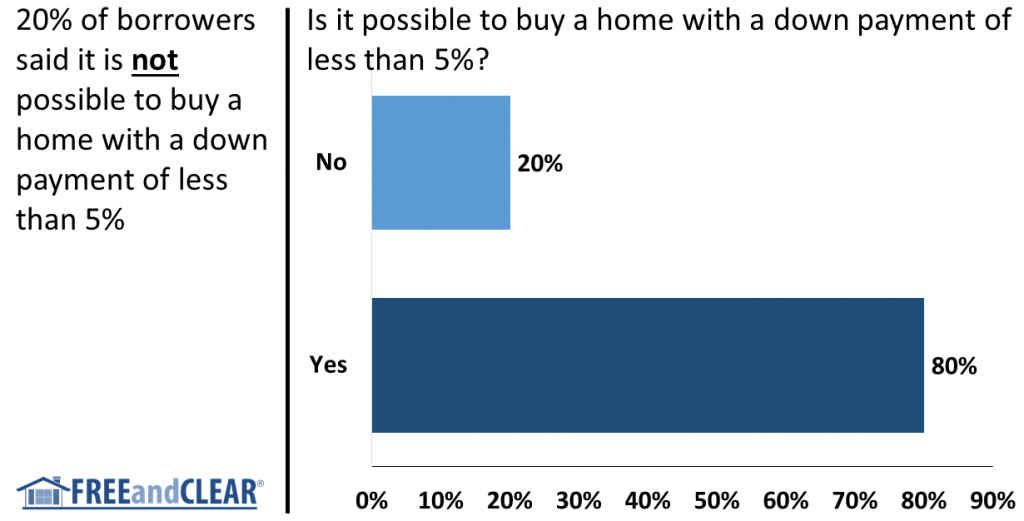
In light of these trends, mortgage programs that enable you to buy a home with little or no down payment should be gaining in popularity.  It appears, however, that a significant portion of borrowers are unaware of the wide range of low down payment programs available to them.  According to the FREEandCLEAR Mortgage Survey, 20% of borrowers said it is not possible to buy a home with a down payment of less than 5%.  So one in five survey respondents may be missing out on home ownership assistance programs that significantly improve their ability afford to buy a home.


Borrowers are unaware of low down payment mortgage programs

Many borrowers are unaware of low down payment mortgage programs


The question becomes, why are more borrowers not aware of these potentially helpful mortgage programs?  There certainly is not a lack of no or low down payment mortgage programs including both government-backed and conventional options.  On the government-sponsored side, the VA and USDA home loan programs enable eligible applicants to buy a home with no money down while the FHA mortgage program requires a down payment of 3.5% and the HUD Section 184 Program only requires a down payment of 2.25% (for loans above $50,000).


On the conventional side, the HomeReady and Home Possible mortgage programs only require a down payment of 3.0%, Fannie Mae also sponsors a standard 3.0% down program and a number of lenders even offer 1% down mortgage programs.  Additionally, Bank of America, Chase, Citibank, Wells Fargo and numerous other lenders offer conventional mortgage programs that enable you to buy a home with a down payment of 3.0% to 5.0%.  Given the countless options it is certainly surprising that many prospective home owners do not know that these programs exist.


Some borrowers might think that no or low down payment mortgage programs were eliminated when tighter lending standards were implemented following the mortgage crisis.  Although new lending guidelines may make it more challenging to qualify for a mortgage, home buyer assistance programs remain a viable option for many borrowers.  In fact, we have experienced an increase in the number of these programs over the past several years.


While it may be impossible to pinpoint why so may borrowers do not know about home ownership assistance programs it is clear that more needs to be done to educate prospective homeowners about the benefits of these programs.  While each program has its pros and cons, including extra costs in some cases, they can be a highly valuable resource for people who think owning a home is out of reach.  Increasing awareness of no and low down payment mortgage programs could help more people buy homes, which is good for both borrowers and lenders.


We will continue to provide a detailed analysis of each survey question on our blog in the coming weeks and you can review the full results from the FREEandCLEAR Mortgage Survey to better understand how borrowers think about and experience the mortgage process.

2018 VA Loan Limits Rise

The recovery in the housing market and higher property values means higher VA loan limits for 2018.  That makes two years in a row that the Federal Housing Finance Agency (FHFA), the government body that the Department of Veterans Affairs uses to determine VA loan limits, increased loan limits.  This is only the second time in over a decade that the VA loan limits increased, demonstrating the general strength of the real estate sector and appreciating home prices.  Specifically, the basic standard 2018 VA loan limit for a single unit property increased by approximately 7%.


The 2018 VA loan limits are important because they are used to determine what size loans are permitted according to VA Home Loan Program guidelines.  In short, the VA guarantees 25% of the loan amount up to the loan limit.  The higher the VA loan limit, the higher the mortgage amount you may be able to qualify for and the more home you can afford.


2018 VA Loan Limits

2018 VA Loan Limits are increasing


Please note that it is possible to obtain a mortgage amount that is greater than the VA loan limit but lenders typically require borrowers to make a down payment equal to 25% of the amount by which the mortgage exceeds the loan limit.  So while technically there is no maximum VA mortgage amount according to program guidelines, in practice the VA loan limits effectively restrict what size mortgage most borrowers can obtain using the VA Home Loan Program.


Below, we outline the VA loan limit changes and summarize the FREEandCLEAR resources you can use to determine the 2018 VA loan limit for your county.  Please note that there is one set of VA loan limits for the contiguous United States, District of Columbia and Puerto Rico and a higher set of loan limits for Alaska, Guam, Hawaii and the U.S. Virgin Islands.  Additionally, within each region there is a basic standard VA loan limit and a high cost VA loan limit for properties located in counties with higher home prices.


2018 VA Loan Limits — United States, District of Columbia and Puerto Rico

In the contiguous United States, Washington D.C. and Puerto Rico, the general VA loan limit increases from $424,100 to $453,100 in 2018. The table below compares the general 2018 VA loan limit to the 2017 loan limit.


Contiguous United States, District of Columbia and Puerto Rico
Basic Standard VA Loan Limits
Number of Units 2018 2017 Change (%)
1 $ 453,100 $ 424,100 6.8%


In the contiguous United States, Washington D.C. and Puerto Rico, the high cost area VA loan limit increases from $636,150 to $679,650 in 2018.  The table below compares the high cost area 2018 VA loan limit to the 2017 loan limit.


Contiguous United States, District of Columbia and Puerto Rico
High Cost Area VA Loan Limits
Number of Units 2018 2017 Change (%)
1 $ 679,650 $ 636,150 6.8%


2018 VA Loan Limits — Alaska, Hawaii, Guam and the U.S. Virgin Islands

The VA loan limits for Alaska, Hawaii, Guam and the U.S. Virgin Islands are higher than the loan limits for the contiguous United States.  In Alaska, Hawaii, Guam and the U.S. Virgin Islands the basic standard VA loan limit increases from $636,150 to $679,650 in 2018.  The table below compares the basic standard 2018 VA loan limit to the 2017 loan limit.


Alaska, Hawaii, Guam and the U.S. Virgin Islands                           
Basic Standard VA Loan Limits
Number of Units 2018 2017 Change (%)
1 $ 679,650 $ 636,150 6.8%


In Alaska, Hawaii, Guam and the U.S. Virgin Islands, the high cost area VA loan limit increases from $954,225 to $1,019,475 in 2018.  The tables below compares the high cost area 2018 VA loan limit to the 2017 loan limit.


Alaska, Hawaii, Guam and the U.S. Virgin Islands                              
High Cost Area VA Loan Limits
Number of Units 2018 2017 Change (%)
1 $ 1,019,475 $ 954,225 6.8%


FREEandCLEAR Resources


As always, all the FREEandCLEAR resources are free to use.  We encourage you to use our tools to understand how the 2018 VA loan limits apply to you.

2018 FHA Loan Limits Increase

The improvement in the housing market and increasing home prices have resulted in higher FHA loan limits for 2018.  2018 represents the second year in a row — and only the second time in over a decade — that FHA loan limits increased.  The higher 2018 FHA loan limits underscore the overall health of the real estate industry as well as rising property values.  Specifically, the basic standard 2018 FHA loan limit for a single unit property increased by approximately 7% as compared to the 2017 FHA loan limit.


2018 FHA Loan Limits

2018 FHA Loan Limits are increasing


The 2018 FHA loan limits are important because they determine the maximum mortgage amount according to FHA Program rules.  In short, the higher the FHA loan limit, the higher the mortgage amount you may be able to qualify for and the more home you can afford.


Loan limits are especially significant for FHA mortgages because borrowers are only required to make a down payment of 3.5% of the property purchase price according to FHA Program guidelines.  Higher FHA loan limits mean that borrowers may be able to afford significantly more home without a proportional increase in their down payment.  For example, the basic standard 2018 FHA loan limit for a single unit property increases by $18,850.  So in 2018 a home buyer could potentially use an FHA loan to buy a home that costs $18,850 more with only a $660 increase in the required down payment.


Below, we outline the FHA loan limit changes and summarize the FREEandCLEAR resources you can use to determine the 2018 FHA loan limit for your county.  Please note that there is one set of FHA loan limits for the contiguous United States, District of Columbia and Puerto Rico and a higher set of loan limits for Alaska, Guam, Hawaii and the U.S. Virgin Islands.  Additionally, within the contiguous United States, District of Columbia and Puerto Rico there is a basic standard FHA loan limit and a high cost FHA loan limit for properties located in counties with higher property values.


2018 FHA Loan Limits — United States, District of Columbia and Puerto Rico

In the contiguous United States, Washington D.C. and Puerto Rico, the basic standard FHA loan limit for a single unit property increases from $275,665 to $294,515 in 2018. The basic standard 2018 FHA loan limit for a four unit unit property increases from $530,150 to $566,425.  The tables below compares the basic standard 2018 FHA loan limits to the 2017 loan limits.


Contiguous United States, District of Columbia and Puerto Rico
Basic Standard FHA Loan Limits
Number of Units 2018 2017 Change (%)
1 $ 294,515 $ 275,665 6.8%
2 $ 377,075 $ 352,950 6.8%
3 $ 455,800 $ 426,625 6.8%
4 $ 566,425 $ 530,150 6.8%


In the contiguous United States, Washington D.C. and Puerto Rico, the high cost area FHA loan limit for a single unit property increases from $636,150 to $679,650 in 2018. The high cost area 2018 FHA loan limit for a four unit unit property increases from $1,223,475 to $1,307,175.  The tables below compares the high cost area 2018 FHA loan limits to the 2017 loan limits.


Contiguous United States, District of Columbia and Puerto Rico
High Cost Area FHA Loan Limits
Number of Units 2018 2017 Change (%)
1 $ 679,650 $ 636,150 6.8%
2 $ 870,225 $ 814,500 6.8%
3 $ 1,051,875 $ 984,525 6.8%
4 $ 1,307,175 $ 1,223,475 6.8%


2018 FHA Loan Limits — Alaska, Hawaii, Guam and the U.S. Virgin Islands

The FHA loan limits for Alaska, Hawaii, Guam and the U.S. Virgin Islands are higher than the loan limits for the contiguous United States.  In Alaska, Hawaii, Guam and the U.S. Virgin Islands the FHA loan limit for a single unit property increases from $954,225 to $1,019,475 in 2018. The 2018 FHA loan limit for a four unit unit property increases from $1,835,200 to $1,960,750.  The tables below compares the general 2018 FHA loan limits to the 2017 loan limits.


Alaska, Guam, Hawaii, and the U.S. Virgin Islands                           
FHA Loan Limits
Number of Units 2018 2017 Change (%)
1 $ 1,019,475 $ 954,225 6.8%
2 $ 1,305,325 $ 1,221,750 6.8%
3 $ 1,577,800 $ 1,476,775 6.8%
4 $ 1,960,750 $ 1,835,200 6.8%


FREEandCLEAR Resources


As always, all the FREEandCLEAR resources are free to use.  We encourage you to use our tools to understand how the 2018 FHA loan limits apply to you.