Category Archives: Uncategorized

Reasons FHA Mortgages Are Popular with Millennials

The FHA mortgage program has been available for over 80 years but recently we have seen a surge in millennial home buyers using the program.  The FHA program offers borrowers of all ages several advantages and we outline below why this old school loan program attracts new school, millennial home buyers.

millennials like FHA loans

FHA mortgages are popular with millennial home buyers


More Flexible Borrower Qualification Requirements
The FHA mortgage program uses relatively flexible qualification requirements including a lower minimum required credit score and potentially higher debt-to-income ratio.  The minimum credit score required to qualify for an FHA loan is 580, which is lower than most mortgage programs.  And if you are willing to make a down payment of 10%, the minimum credit score is as low as 500.  Additionally, although the standard debt-to-income ratio limit for the FHA mortgage program is 43%, applicants with stronger financial and credit profiles may be able to qualify for a mortgage with a debt-to-income ratio over 50%.  The lower minimum credit score and higher maximum debt-to-income ratio make it easier for millennials to qualify for an FHA loan, especially if they have a limited credit profile or a few dings on their credit report.


Low Down Payment
The FHA mortgage program enables homebuyers to purchase a home with a down payment as low as 3.5% as compared to the 10% – 20% down payment required by many standard mortgage programs.  Saving money for a down payment can be one of the biggest obstacles to buying a home, especially for millennials with student loans or who struggle to make rent payments.  By reducing the down payment required to buy a home, the FHA mortgage program makes homeownership more attainable for millennial home buyers.


Lower FHA Mortgage Rates
FHA mortgage rates are typically .250% – .500% lower than the interest rate for other low down payment mortgage programs.  The interest rate for an FHA loan is lower because the program is backed by the government and borrowers are required to pay FHA mortgage insurance, which protects the lender in the event of default or foreclosure.  Lower FHA mortgage rates bring down your monthly mortgage payment and potentially save you thousands of dollars in interest over the life of your loan.  Fiscally responsible millennials looking to save money on their mortgage payment are attracted to the lower interest rates offered by FHA loans.


Live Wherever You Want
Some low or no down payment loan programs require the property being mortgaged to be located in a specific geographic area to qualify for certain program benefits, such as a reduced mortgage rate.  The FHA mortgage program does not restrict where a property is located which means that millennials can use the program in any hip and up-and-coming neighborhood they want.


Earn As Much Money as You Want
The FHA mortgage program does not restrict how much money borrowers can earn.  Several other low or no down payment programs use a maximum income limit to determine borrower eligibility, which may reduce the number of borrowers that are eligible for the programs, especially in more expensive cities.  By not applying borrower income limits, the FHA mortgage program is available to millennial home buyers of all income levels.


Given the program benefits outlined above, you can understand why FHA mortgages appeal to millennials and prospective home buyers of any generation.

How Do Borrowers Learn About Mortgages?

In our last FREEandCLEAR Mortgage Survey post we discussed how less than one in five borrowers learn about the mortgage process in high school or college.  If borrowers are not learning about mortgages in the classroom, where are they learning?  It turns out, most borrowers are turning to the Internet, their lender and real estate agents to understand how mortgages work.


According to the FREEandCLEAR Mortgage Survey, when we asked borrowers “from what source have you learned the most about the mortgage process”, the Internet and Lender tied for the top response, with both options garnering 24% of responses.  Realtor / real estate agent came in third, with 15% of responses as they continue to play an important, albeit secondary role, in the mortgage education process .  Not surprisingly, school only attracted 5% of responses, reinforcing our prior findings about how the education system fails mortgage borrowers.


It is also notable that only 2% of mortgage borrowers selected the Consumer Finance Protection Bureau (CFPB) as the source from which they have learned most about the mortgage processIn fairness, the CFPB was established relatively recently which may help explain its lack of awareness or usage among borrowers in our survey.  Despite this, 2% is still a very low portion of responses in light of the CFPB’s significant resources and support.  While the CFPB can be a political lightning rod, it does offer a wide range of educational resources for prospective mortgage borrowers.


how borrowers learn about mortgages

Most borrowers use the Internet and their lender to learn about mortgages


The results of the FREEandCLEAR Mortgage Survey illuminate several interesting points about how borrowers learn about mortgages.  First, more borrowers are turning to the Internet to research mortgages.  We expect this trend to grow over time as more millennials enter the home buying market.  Although the Internet can be an inconsistent information source, it is positive that borrowers have more free mortgage tools and resources available to them.


Second, borrowers continue to rely on their lenders to learn about the mortgage process.  While this finding seems somewhat obvious it raises issues about objectivity and potential conflicts of interest between lender and borrowers.  Turning to a lender for mortgage education works with qualified, ethical lenders but borrowers working with less established or experienced lenders may be disadvantaged.  Additionally, borrowers who consult multiple lenders are more likely to make informed mortgage decisions.


Finally, the FREEandCLEAR Mortgage Survey showed that 30% of borrowers learned about the mortgage  process from “Other” sources, underscoring the myriad methods that people use to learn about mortgages.


It is clear from our survey results that borrowers use numerous resources to learn about the mortgage process.  Whether they use the Internet, lenders, realtors or a government agency, the most important point is that borrowers seek to learn about mortgages and borrower education improves over time.  Educated borrowers makes more informed mortgage decisions which benefits all mortgage process participants.


We will continue to provide a detailed analysis of each survey question on our blog in the coming weeks and you can review the full results from the FREEandCLEAR Mortgage Survey to better understand how borrowers think about and experience the mortgage process.

Education System Fails Mortgage Borrowers

Although a mortgage is one of the biggest financial commitments most people make, many borrowers are undereducated or misinformed about the mortgage process.  One of the primary reasons borrowers find the mortgage process challenging and overwhelming is because they do not learn about it in school, at any level.  The results of the FREEandCLEAR Mortgage Survey reinforce how little financial literacy education students receive in our education system, especially as it pertains to important topics such as mortgages.


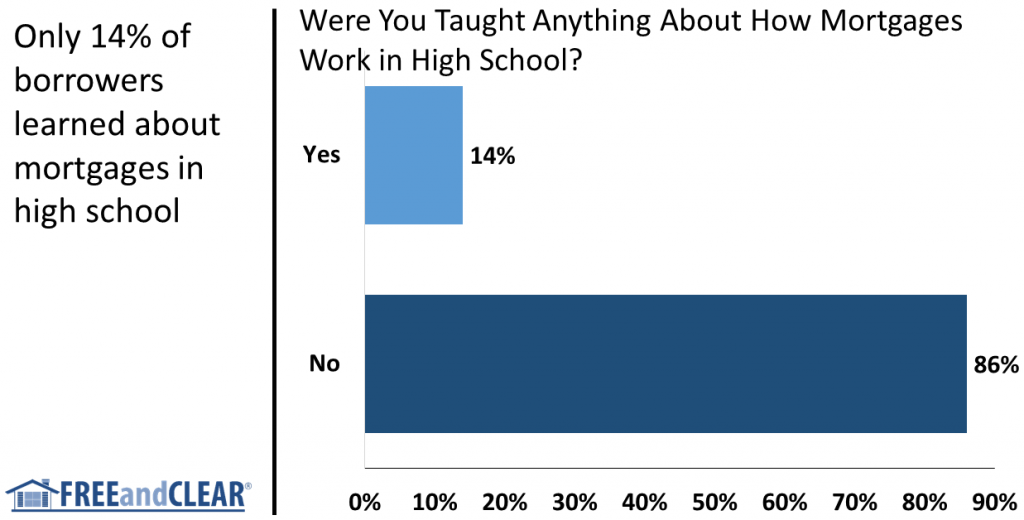
According to the FREEandCLEAR Mortgage Survey, only 14% of borrowers said they learned about the mortgage process in high school.  Or in other words, 86% of borrowers did not learn about mortgages in high school.


How many borrowers learned about mortgages in high school

Most borrowers did not learn about mortgages in high school


While high school students are usually several years away from getting a mortgage to buy a home, the lack of education is eye-opening.  Teaching people about mortgages at an earlier age empowers them to make better decisions when they apply for a loan in the future.  Being more knowledgeable about the mortgage process also makes people less susceptible to scams and fraud, which can save them thousands of dollars and reduce financial hardship.  Additionally, improved financial literacy education in high school can help borrowers understand how the decisions they make when they are young, such as overusing a credit card, can impact their ability to qualify for a mortgage in the future.


The mortgage education picture does not look much better when you look at college.  According to the FREEandCLEAR Mortgage Survey, only 17% of borrowers said they learned about the mortgage process in college, a figure that is only slightly better than high school education rate.  So less than one in five borrowers are taught, or elect to learn, about mortgages in college, which is shockingly low.


how many borrowers learned about mortgages in college

Most borrowers also did not learn about mortgages in college


Most borrowers spend the majority of their adult lives paying their mortgage yet spend almost no time learning about mortgages in high school or college.  At FREEandCLEAR we often come across incredibly bright, highly-educated people who struggle to understand the mortgage process because so little attention is paid to it in high school or college classrooms.  In many cases, borrowers are learning about the mortgage process for the first time when they apply for a loan and they may not have access to knowledgeable education resources.  Knowledge is power so perhaps that is why so many people feel powerless when it comes to getting a mortgage — a lesson that we painfully experienced as a country in the aftermath of the real estate crisis less than ten years ago.


We recognize that the U.S. education system is under strain at all levels and is certainly not responsible for teaching all subjects.  But for something as important as financial literacy and mortgages, a little education can make a huge difference.


We will continue to provide a detailed analysis of each survey question on our blog in the coming weeks and you can review the full results from the FREEandCLEAR Mortgage Survey to better understand how borrowers think about and experience the mortgage process.

Mortgage Bait and Switch — Perception Versus Reality

Let’s face it, the mortgage lending industry does not have the best reputation.  Much of the dissatisfaction is centered around the idea that lenders bait and switch borrowers, or promise attractive terms upfront to win your mortgage business but then fail to deliver those terms when it comes time to close your loan.  Changing terms at the last minute when borrowers are desperate to close their loan causes serious borrower frustration and even anger.


The practice of baiting and switching draws the ire of borrowers and has attracted significant attention from government regulators.  New rules and disclosures are designed to limit how much mortgage terms can change from the beginning of the mortgage process until when your loan closes, thereby limiting bait and switch tactics.


Tips to Avoid a Bait and Switch

  • Shop Lenders.  Shopping multiple lenders is one of the best ways to save money on your mortgage and helps you avoid a bait and switch.  FREEandCLEAR recommends that borrowers compare at least four lenders when you get a mortgage, including different types of lenders.  Borrowers can use our INTEREST RATES feature to compare mortgage rates and fees for lenders in your area.
  • Put it In Writing.  When you shop for a mortgage, make sure that you request a written proposal from lenders.  You should request a Loan Estimate and Lender Fees Worksheet that outlines the key terms of the mortgage including interest rate and closing costs.  Having a written mortgage proposal reduces the probability of a mortgage bait and switch.
  • Be Prepared.  Make sure that you know your credit score and organize your personal financial information such your bank statements, pay stubs and tax documents.  Knowing your credit score will help you avoid surprises and organizing your financial information helps speed up the mortgage process.
  • Lock Your LoanLocking your loan protects you against an increase in mortgage rates and is one of the best tactics to combat a mortgage bait and switch.  Depending on the length of your lock period, you may be required to pay a moderately higher interest rate but locking your loan provides certainty for your mortgage terms.  Make sure that the length of your lock period is long enough to close your mortgage.
  • No Big Changes.  After you apply for your mortgage, avoid making any big life changes or significant financial decisions until your mortgage closes.  For example, it is best for borrowers to avoid changing jobs or making any major purchases until after their loan closes.  These events can impact your credit score and financial profile and may provide lenders with the opportunity to change your loan terms so borrowers are almost always better off waiting before they make any big changes.


The heightened government scrutiny raises the question: how common is the mortgage bait and switch?  According to the FREEandCLEAR Mortgage Survey, the answer is not common at all.  Survey results show a combined 93% of borrowers said their mortgage rate stayed the same (70%) or decreased (23%) from when they selected their mortgage lender until when their mortgage closed, a relatively low number given the perceived prevalance of baiting and switching in the mortgage industry.  In fact, it is relatively noteworthy that almost one quarter of survey respondents experienced a decrease in their interest rate over the course of the mortgage process.


how did you mortgage rate change over course of mortgage process

Most borrowers said their mortgage rate stayed the same or decreased from the beginning to end of the mortgage process


Survey participants were also asked how their closing costs changed from the beginning to the end of the mortgage process.  Lenders may be delivering the mortgage rate they promised but does that come at the expense of higher closing costs? The answer appears to be no.  A combined 94% of borrowers said their mortgage closing costs stayed the same (78%) or decreased (16%) from when they selected the mortgage lender until when their mortgage closed.


How did your closing costs change from the beginning to end of the mortgage process

Most borrowers said their closing costs stayed the same or decreased from the beginning to end of the mortgage process


The FREEandCLEAR Mortgage Survey suggests that the lender bait and switch is a relatively uncommon practice and there are several factors that help explain the findings.  First, the steady interest rate environment over the past several years makes easier for lenders to deliver the mortgage rate they quoted borrowers.  It will be interesting to review this topic again in a more volatile and inflationary interest rate market.  Second, with mortgage rates being relatively low, borrowers are more inclined to feel positive about their interest rate and less susceptible to, or aware of, a bait and switch.


The other influence that we referenced above is that new regulations are intended to make it more challenging for lenders to increase interest rates and closing costs at the end of the mortgage process.  Although implementing TRID and issuing Loan Estimates and Closing Disclosures may have made the mortgage process more cumbersome, perhaps they have been effective in increasing transparency and reducing last minute changes to loan terms.


Although the FREEandCLEAR Mortgage Survey is overwhelmingly positive on the bait and switch topic, the results also show that 7% of borrowers experienced an increase in mortgage rate and 6% of borrowers experienced an increase in closing costs from when they selected their lender until their mortgage closed.  While loan terms are always bound to change for a small number of borrowers due to factors outside of lenders’ control (such as a change in credit score or unexpected appraisal report), these borrowers likely represent a small but very vocal minority that should not be ignored.


The proper implementation of government regulations along with conservative lending practices and improved communication should continue to reduce bait and switch incidents in the future.  As more borrowers get the mortgage rate and closing costs they were promised, the perception of the mortgage industry should move closer to reality, which is positive for borrowers, lenders and regulators.


We will continue to provide a detailed analysis of each survey question on our blog in the coming weeks and you can review the full results from the FREEandCLEAR Mortgage Survey to better understand how borrowers think about and experience the mortgage process.

Disaster Relief Mortgage Program Helps Communities Rebuild

As disaster victims in several states start the process of rebuilding in the aftermath of the damage inflicted by hurricanes Irma and Harvey, FREEandCLEAR want to shine a spotlight on a government-backed home loan program that can help communities rebuild their homes as well as their lives.


The FHA 203(h) Program enables borrowers that live in Presidentially-designated disaster areas and whose homes were destroyed or seriously damaged to purchase a home with no down payment as compared to the 3.5% down payment required for a regular FHA mortgage and the 5% – 20% down payment typically required by conventional mortgage programs.  The ability to get a home loan and buy a home with no down payment can help financially challenged disaster victims recover more quickly following a natural disaster.


Similar to the regular FHA Home Loan Program, other advantages of the FHA 203(h) Program include lower FHA interest rates and more flexible qualification guidelines, including a lower minimum borrower credit score.  Additionally, the FHA 203(h) Home Loan Program does not require that borrowers maintain savings in reserve at the time the loan closes, lessening the financial contribution required to get a mortgage.


Another benefit an 203(h) Loan is that it can be used to both buy or reconstruct a home.  The flexibility to utilize a loan for the reconstruction of a property is unique to the the FHA 203(h) Mortgage Program and highly valuable in areas that are rebounding from severe damage caused by a natural disaster.  The program also applies to both purchase loans and refinances, further enhancing its flexibility and value to borrowers.  To summarize, the FHA 203(h) Program makes buying or rebuilding a home more affordable for natural disaster victims.


Among the handful of negatives of the FHA 203(h) Home Loan Program, borrowers are required to pay an upfront and ongoing mortgage insurance premium. The ability to buy a home with no money down plus lower FHA interest rates balance the extra cost to borrowers.  The FHA also applies mortgage limits that restrict the size of loan you can obtain.  Borrowers that reside in high cost communities may find that the FHA mortgage limits restrict their home purchase or rebuilding options.


To make it easier for borrowers to apply for the FHA 203(h) Program, HUD has implemented procedures to accelerate the mortgage process.   Lenders with a direct endorsement from the FHA are allowed to review a loan application without sending additional documents or information to the FHA.  This approach streamlines the loan application process so that disaster victims can re-establish their roots faster.

 
You can apply for the FHA 203(h) Mortgage Program through FHA-approved lenders such as banks, mortgage banks, mortgage brokers and credit unions.  Please note that only FHA-approved lenders can offer the FHA 203(h) Program.  Borrowers should confirm that their lender is approved by the FHA before submitting their loan application.  To be eligible for the FHA 203(h) Home Loan Program, borrowers are required to submit their loan application within one year of the President declaring a county a disaster area.


Please visit FREEandCLEAR’s comprehensive overview of the FHA 203(h) Program for more information.

How Do Borrowers Really Feel About Their Mortgage?

In the aftermath of the real estate crisis many borrowers expressed intense dissatisfaction toward their mortgage lenders.  Right or wrong, borrowers often accused lenders of putting them in bad mortgages that they did not really understand and could not really afford.  Although we do not have official statistics that measure borrower sentiment in 2008, it is safe to assume that hundreds of thousands of borrowers, if not more, claim they got a “raw deal” on their mortgages.


Fast forward almost ten years and how do current borrowers feel about their mortgages? According to the FREEandCLEAR Mortgage Survey, the vast majority of borrowers feel pretty good.  When asked “Do you feel like you got a good deal on your mortgage?” 90% of survey respondents selected yes as compared to only 10% who chose no.  In short, almost all borrowers feel like they got a good deal on their mortgage.


how do borrowers feel about their mortgage

90% of borrowers said they got a good deal on their mortgage


The results of this survey question certainly reflect well on mortgage lenders and show how much progress the lending industry has made over the past several years.  It is quite a remarkable turnaround given the state of the industry and borrower sentiment in the not so distant past.  So what is driving this newfound and very much welcome borrower positivity?


There are likely multiple factors that explain the FREEandCLEAR Mortgage Survey results.  First, whether they were coerced by regulators or on their own volition, lenders eliminated many of the exotic mortgage programs that contributed to much of the borrower dissatisfaction, frustration and anger.  Mortgages with negative amortization and pay-option ARMs have all but disappeared from the lending marketplace.  While it has definitely become more challenging to qualify for a mortgage, more borrowers are likely getting loans that they understand and can afford which leads to improved borrower sentiment toward lenders.


There are also macro factors that contribute to the positive vibes from borrowers.  The economy has stabilized, property values have improved and the mortgage default rate continues to hover near record lows.  More people staying in their homes certainly has a positive impact on how they feel about their mortgages.  Mortgage rates also remain near multi-decade lows which makes owning a home and paying the mortgage more affordable.  It is not a stretch to suggest that the lower your interest rate, the more likely you are to feel like you got a good deal on your mortgage and our survey results support this hypothesis.


While the FREEandCLEAR Mortgage Survey is overwhelmingly positive, it also shows that 10% of borrowers do not feel like they got a good deal on their mortgage.  While 100% customer satisfaction is impossible in any industry, the survey findings show that mortgage industry has room for improvement.  When you extrapolate the results across millions of borrowers it means that a lot of people do not feel positive about their mortgage.  The survey also makes us wonder how borrowers sentiment may shift if mortgage rates rise or if the real estate market falters.   For now, however, much-maligned lenders should be satisfied to know they are providing borrowers with a good deal on their mortgage.


We will continue to provide a detailed analysis of each survey question on our blog in the coming weeks and you can review the full results from the FREEandCLEAR Mortgage Survey to better understand how borrowers think about and experience the mortgage process.

What is the Most Important Factor When Borrowers Select a Mortgage?

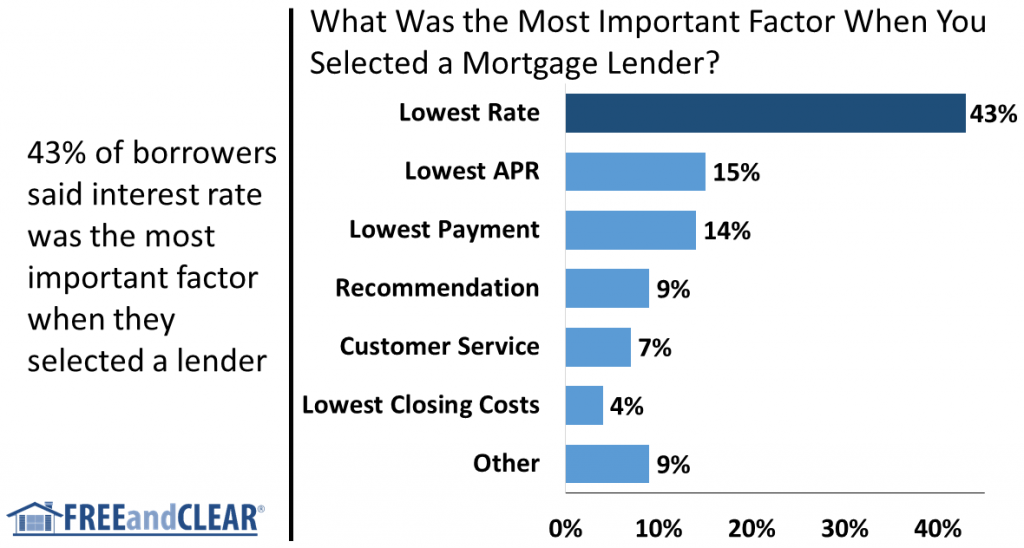
There are many reasons to select a mortgage lender — an existing relationship, excellent custom service, positive recommendation — but one factor stands out to borrowers by an almost three-to-one margin according to the FREEandCLEAR Mortgage Survey.


When asked “What was the most important factor when you selected a mortgage lender?”, 43% of borrowers selected “lowest rate”, which topped the next highest response by almost 30%.  The results of the survey demonstrate that borrowers are keenly focused on finding the lender that offers the lowest interest rate when they shop for a mortgage.  While it is not surprising that borrowers focus on mortgage rate when selecting a lender, the margin by which “lowest rate” topped our survey does illuminate some interesting issues about the mortgage process.


most important factors when borrowers select a mortgage lender

Lowest rate is the most important factor when borrowers select a mortgage lender


It is telling that “APR” was the (distant) second-ranked selection, attracting only 15% of  borrower responses.  APR is similar to interest rate but also incorporates certain closing cost inputs.  Because it reflects both interest rate and closing costs, APR is intended to represent the “true cost” of a mortgage.  According to government regulations, lenders are required to disclose the APR when they provide borrowers with a mortgage quote and the APR is supposed to enable borrowers to more easily compare mortgage proposals across multiple lenders.  Unfortunately, the feedback we hear from many borrowers is that APR is too complicated to calculate and understand so it comes as no surprise that they focus on mortgage rate instead of APR when they select lenders.


With 14% of responses, “Lowest Payment” barely trailed APR and was the third-ranked response in the survey.  Borrowers looking to stretch their monthly budgets are often highly focused on finding the mortgage with the lowest monthly payment.  Your mortgage payment is directly related to your interest rate (the number one response in our survey) but is also impacted by mortgage program and loan term.  The survey findings suggest that borrowers may be interested in adjustable rate mortgages (ARMs) that offer a lower initial interest rate and monthly payment.


Moving past the top three survey results, the bottom half of the survey is perhaps equally informative as the top half.  Qualitative factors such as recommendation and customer service lag more quantitative decision-making criteria such as interest rate.  Only 9% of borrowers selected “Recommendation” as the most important factor when they selected a mortgage lender and only 7% of borrowers chose “Customer Service.”  The survey findings imply that borrowers are willing to tolerate mediocre customer service to get a lower mortgage rate.  Of course a low interest rate combined with excellent customer service is the ideal option but it is interesting to understand borrower priorities.


Finally, coming in at sixth place in our survey, only 4% of borrowers selected “Lowest Closing Costs” as the most important lender selection factor.  This result demonstrates that borrowers may be willing to incur higher closing costs, such as paying discount points, to lower their mortgage rate and monthly payment.  Additionally, lenders that offer mortgage options with a range of interest rates and closing costs are more likely to meet borrowers’ needs.


As much as the mortgage process has evolved over the past decade with new regulations, technologies and lenders, the FREEandCLEAR Mortgage Survey shows that not much has really changed when borrowers select a mortgage lender.  While lenders attempt to entice borrowers with greater speed and functionality and borrowers have more ways than ever to search for, compare and evaluate lenders, the mortgage selection process always comes down to one number: your mortgage rate.


We will continue to provide a detailed analysis of each survey question on our blog in the coming weeks and you can review the full results from the FREEandCLEAR Mortgage Survey to better understand how borrowers think about and experience the mortgage process.

Borrowers Continue to Turn to Big Banks When Shopping for a Mortgage

Big banks may be losing share of the mortgage market but they continue to hold mindshare when borrowers shop for mortgages.  While specialized mortgage banks have experienced significant growth over the past several years, most mortgage borrowers still turn to big banks when they compare lenders according to the FREEandCLEAR Mortgage Survey.


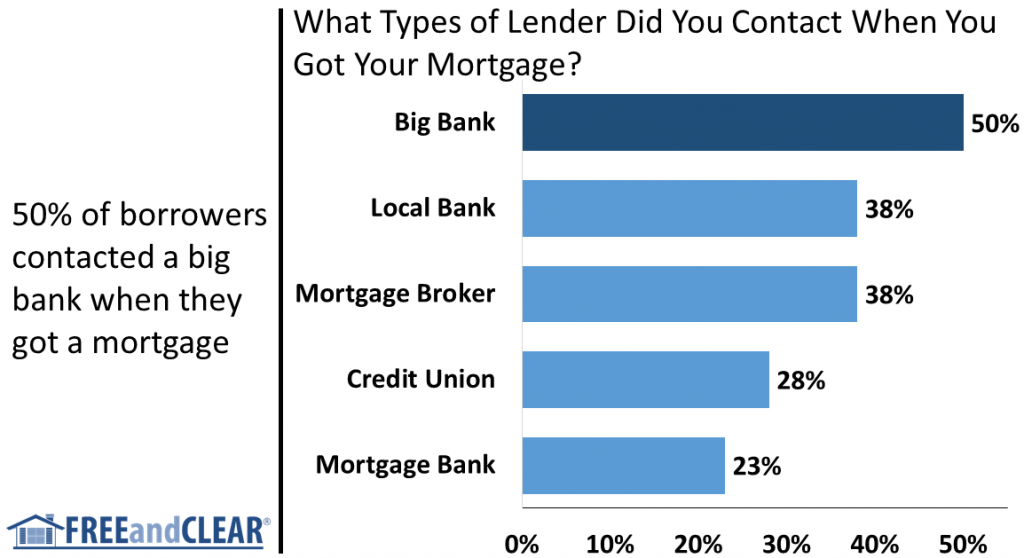
When asked “what type of lenders did you contact when you got your mortgage (select all that apply)?”, 50% of borrowers selected “Big Bank”, which ranked as the top survey response.  Given the tarnished reputation of big banks as well as recent scandals, we were somewhat surprised that borrowers selected big bank more than any other type of lender.  The high ranking for big banks is likely attributable to borrowers having existing checking or savings account relationships with the banks as well as borrowers wanting to get a mortgage quote from a known brand.


types of lenders for mortgage

Types of lenders borrowers contact for a mortgage


The surprising results extended beyond the top of the survey as smaller, local lenders placed relatively high.  “Local Bank” and “Mortgage Broker” tied for the second highest response, with each type of lender garnering 38% of borrower responses.  Industry regulations implemented since the mortgage crisis have made business more challenging for both smaller lenders and mortgage brokers but they continue to be an important resource for borrowers and more importantly, a viable lending option.  The results of the FREEandCLEAR Mortgage Survey suggest that borrowers like having multiple lender choices — both big and small — when they shop for a mortgage.


The bottom results of the survey are also highly informative with “Credit Union” and “Mortgage Bank” ranking fourth and fifth, respectively.  28% of borrowers said that they contacted a credit union when they got a mortgage, which is roughly consistent with credit unions’ share of the overall mortgage market.  As credit unions continue to grow their membership bases and expand their mortgage lending options you would expect them to increase their borrower mindshare in the future.


Perhaps the most surprising finding from the survey is that only 23% of borrowers said that they contacted a “Mortgage Bank” when they got a mortgage.  Mortgage banks that focus exclusively on mortgages without taking borrower deposits or offering other lending products have gained significant market share over the past half decade.  Despite their strong growth, mortgage bank attracted the lowest response rate among surveyed borrowers.  There are several possible explanations for why mortgage bank ranked so low.  First, because the definition of a mortgage bank is relatively technical, borrowers may not differentiate between a mortgage bank and other types of lenders when they shopped for their loan.  We hypothesize that a higher percentage of borrowers contacted mortgage banks without actually realizing the lender was a mortgage bank.


The second factor that contributed to the disconnect is that while fewer borrowers may shop mortgage banks, more borrowers may select them for their loan.  For example, a borrower may not contact multiple lenders before deciding to use a mortgage bank for their loan.  Larger mortgage banks tend to advertise heavily which may attract more customers directly.  While FREEandCLEAR advocates that borrowers always shop multiple lenders for a mortgage, some borrowers may be persuaded by a lender’s marketing messages.  Whatever the reason, we expect mortgage banks to attract a greater share of mortgage shoppers in the future.


While the mortgage lender landscape continues to shift, the results of the FREEandCLEAR Mortgage Survey reinforce how important options are for borrowers.  Whether borrowers contact old school big banks, local banks or mortgage banks, the ability to shop multiple types of lenders remains key to borrowers finding the mortgage that is right for them.


We will continue to provide a detailed analysis of each survey question on our blog in the coming weeks and you can review the full results from the FREEandCLEAR Mortgage Survey to better understand how borrowers think about and experience the mortgage process.